
The Amendment That Just Passed
On 30 June 2026, the Dewan Rakyat approved amendments to the Employment Insurance System (Amendment) Bill 2025, giving legal force to a progressive penalty structure for employers who fail to notify PERKESO of job vacancies before hiring. The law itself, Section 45F of the Employment Insurance System Act, has been on the books for some time. What just changed is the penalty for ignoring it.
Under Section 45F, every Malaysian employer must post job vacancies or newly created positions on the MYFutureJobs portal, PERKESO’s national job platform, before hiring for those positions. The requirement is not optional. It is not conditional on the position’s seniority, salary band, or industry. Every vacancy, every new position, must be reported before the hire.
For years, most Malaysian companies have treated this obligation as a formality, posting on JobStreet, LinkedIn, or through recruitment agencies while skipping MYFutureJobs entirely. That treatment is now legally exposed.
The Progressive Fine Structure
The original Bill passed on 2 December 2025 proposed a flat maximum penalty of RM10,000 for non-compliance. The Dewan Negara amended that on 12 March 2026, introducing a progressive structure that scales with repeat offences, and the Dewan Rakyat has now approved the revised version.
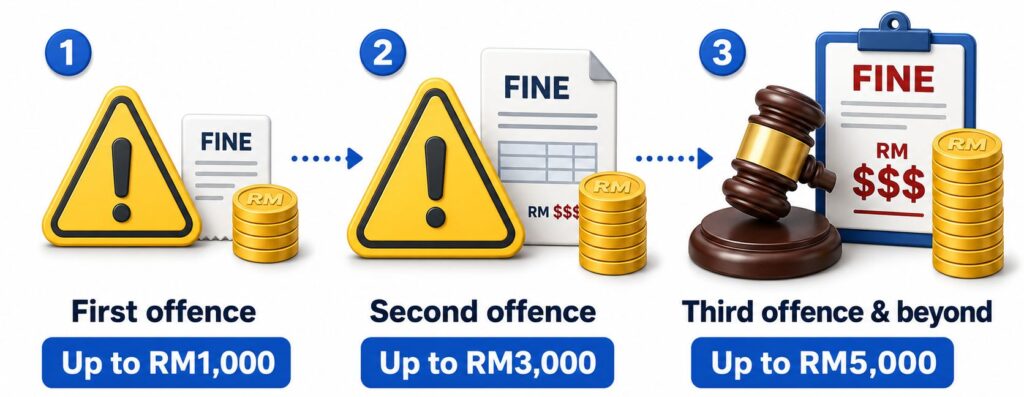
First offence: up to RM1,000. The Deputy Human Resources Minister has indicated that enforcement will begin with warnings before fines are imposed. Companies caught at this stage will typically be advised to bring their reporting into compliance rather than immediately fined, though the fine remains a legal option.
Second offence: up to RM3,000. The escalation triples. At this point, PERKESO is signalling that the first warning was insufficient. Companies reaching this tier are already on the enforcement radar for future audits.
Third offence and beyond: up to RM5,000. Each subsequent unreported vacancy compounds the risk. A company with multiple unreported hires across a year can accumulate fines quickly, and the pattern of non-compliance itself becomes evidence of intent.
The tiered design is not lenient. It is progressive, and companies that treat the first warning as a free pass discover the compounding on the second visit.
What MYFutureJobs Actually Requires
MYFutureJobs is operated by PERKESO as part of the Employment Insurance System infrastructure. Its primary function is to match retrenched workers, EIS beneficiaries, and other jobseekers with available positions. When a company posts a vacancy on the platform, it enters the national job-matching pool that PERKESO uses to place displaced workers back into employment.
The posting requirement is straightforward but often misunderstood. Every job vacancy or newly created position must be posted before recruitment for that position begins. The posting does not restrict the employer from using other recruitment channels. Companies can still advertise on JobStreet, LinkedIn, or through agencies. MYFutureJobs is a legal minimum, not an exclusive channel.
The platform itself is free to employers. PERKESO provides free candidate matching, shortlisting, and job fair invitations at no additional cost. As of the end of 2025, over 170,000 Malaysian employers were already registered on the platform, and the portal recorded more than 1.3 million vacancies with over 200,000 successful placements in the year prior. The system works. The question is whether employers use it.
Why Compliance Was Optional Until It Wasn’t
For most Malaysian companies, MYFutureJobs sat in the same mental category as the various government portals HR staff learn about at compliance seminars, register for once, and rarely visit again. The obligation existed on paper. Enforcement was gentle. The absence of a specific penalty meant most non-compliance produced no consequence.
The 30 June amendment closes that gap. The penalty is now specific, tiered, and legally enforceable. The warning-first approach means early enforcement will be educational rather than punitive, but the warnings themselves become part of the company’s compliance record, and each subsequent unreported vacancy multiplies the exposure.
The shift is not just about the fine. It is about what the fine signals. Section 45F is now being treated as an active enforcement priority, not a dormant provision. Companies that continue hiring without posting to MYFutureJobs are running against active regulatory attention.
What HR Should Do Now
The operational adjustment is smaller than the compliance risk suggests. HR teams should build a simple habit into every hiring cycle: before recruitment for any position begins, post the vacancy on MYFutureJobs. The posting takes minutes, costs nothing, and satisfies the legal minimum.
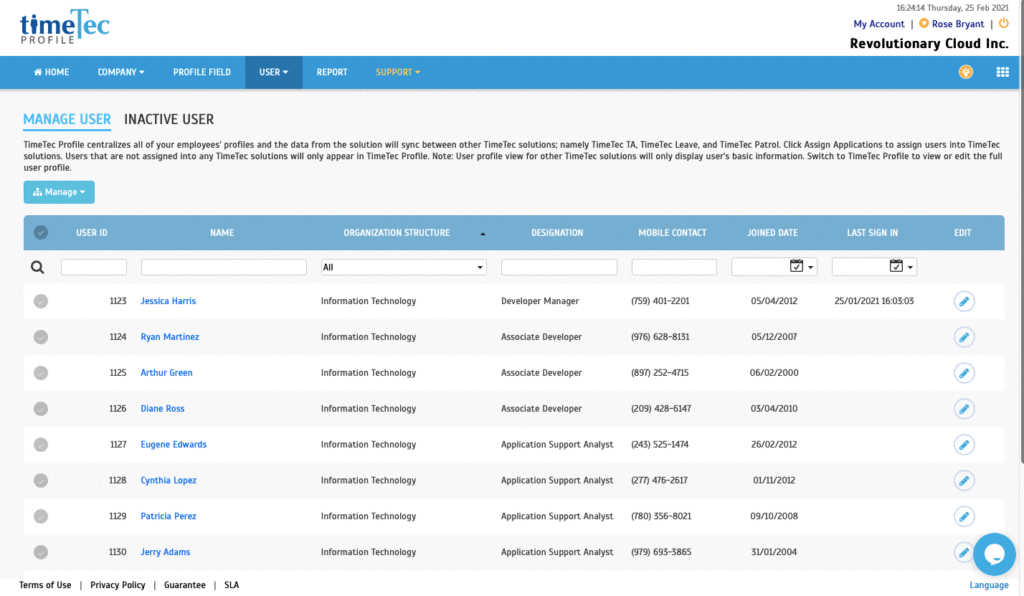
The trigger event is the moment a vacancy exists, whether from a resignation, a promotion that opens an upstream role, or a newly approved position. For companies already using TimeTec HR, workforce transitions like resignations and new position approvals are recorded in the employee record, giving HR the underlying visibility to recognise when a vacancy has opened. The operational habit of posting to MYFutureJobs is what closes the compliance loop.
The rest is process discipline. Add the MYFutureJobs posting to the standard recruitment checklist. Track posting confirmations alongside the recruitment file. Make sure the person responsible for kicking off any hiring cycle knows the posting is a compliance step, not an optional one.
The Portal Was Optional. It Isn’t Anymore.
Section 45F has moved from soft obligation to enforceable law. The progressive fines are not the largest penalties in Malaysian employment law, but they are compounding, and the pattern of non-compliance becomes the evidence in later audits. The company that treated MYFutureJobs as optional last year is the same one facing a first warning this year, and the fine tier the year after that.
For HR teams, the fix is one line added to the recruitment checklist. For companies that skip that line, the fine schedule now writes itself.