
The Approval That Isn’t One
Most expense claims are approved in the time it takes to glance at a name and click a button. A manager sees a familiar face, a plausible amount, a receipt attached, and waves it through, because scrutinising every claim would take longer than the work the claim was for. Multiply that reflex across a team, a month, a year, and the total that passes without a second look is not small.
This is where quiet leakage lives. Not in dramatic fraud, but in the steady drift of claims that were never really checked, only cleared.
Where the Leakage Actually Hides

Expense abuse is rarely bold. It is the padded taxi fare, the dinner receipt that was personal, the same receipt submitted twice a few months apart, the “miscellaneous” line that no policy actually allows. It is the claim pitched just under the amount that would have triggered a closer look, submitted by someone who has learned exactly where that line sits.
None of these survive a proper check. All of them survive a reflex. And because each one is individually small, none of them ever feels worth the confrontation, so they accumulate as a cost the company absorbs without ever deciding to.
The problem is not that employees are dishonest. Most are not. The problem is that a process which relies on the approver catching everything will, reliably, catch almost nothing.
Why the Reflex Wins
Ask why claims get rubber-stamped and the honest answer is structural. The approver often has no policy limit in front of them to check the amount against, so “reasonable” is a judgement made from memory. They rarely compare a receipt to a previous month, so a duplicate is invisible. And the cost of querying a colleague’s RM40 claim feels higher than the cost of just approving it.
So the check that the whole process depends on is the one part of it that is never actually resourced. The control exists on paper, in a claims policy nobody reads at the moment of approval, and not in the moment itself.
The Control Belongs in the Process, Not the Approver’s Memory
The fix is to stop asking the approver to be the control, and build the control into the claim itself. TimeTec Claim lets you define each claim type with its own policy and limit, so a claim above what the policy allows is flagged before it reaches an approver rather than after. It requires the receipt to be attached at submission, keeps every claim and its approval on an audit trail that can be reviewed later, and routes each claim to the right approver instead of whoever is nearest. The finance reports then let the same data be checked in aggregate, where a pattern of small, repeated claims becomes visible in a way no single approval ever reveals.
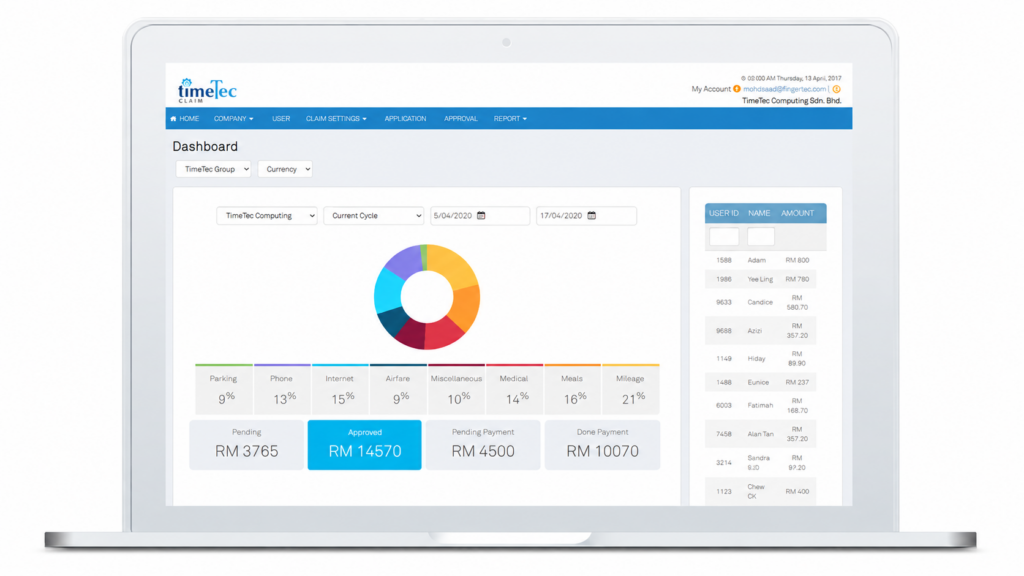
The point is not to treat every employee as a suspect. It is the opposite. When the limits, the receipt, and the record are enforced by the system, the honest majority are cleared automatically and fairly, and the few claims that fall outside the rules are the only ones that need a human to look twice. As the argument in Your Expense Claim Process Still Runs on WhatsApp made clear, a claim living in a chat thread has no policy, no limit, and no trail. This is the other half of that story: digitising the claim is only useful if the digitised claim also carries the rules.
A Claim Is Approved, or It Is Checked. Rarely Both.
Every company believes its approvers are its expense control. Almost none have given those approvers what they would need to actually be one. The leakage is not a people problem to be solved with a stern email. It is a process gap, and it closes only when the rules travel with the claim.
An approval should mean the claim was checked. Right now, in most companies, it only means someone was in a hurry.