
What 49 Officers Asked For
In August 2025, a coordinated labour enforcement operation deployed 49 officers from five Malaysian agencies to a single manufacturing company in Kuala Lipis, Pahang. The Department of Labour Peninsular Malaysia (JTKSM) led the inspection. The team also included the Social Security Organisation (PERKESO), the Employees Provident Fund (EPF), the Immigration Department of Malaysia (JIM) and the Royal Malaysian Police (PDRM). The complaint that triggered the visit covered the termination of local workers while foreigners were retained, the payment of termination benefits in instalments, and accommodation the agencies found poor and unhygienic. Multiple offences under the labour laws were established.
For most Malaysian companies preparing for compliance, the visit format itself was the lesson. A single agency. A single set of questions. A single point of contact. None of that held. Five agencies came in together, asked overlapping but different questions, and produced findings that no single department of the company could answer in isolation.
The joint operation is no longer an outlier. It is the direction Malaysian labour enforcement has chosen, and the company that has prepared its records for one inspector from one agency is the same one that will face a coordinated team and not be ready for any of them.
The Five Questions Behind the Five Agencies
Each agency in a joint operation comes in with its own brief, but the records each one demands overlap heavily in the same employee data.
JTKSM is asking about working hours, overtime within the 104-hour monthly cap, rest day compliance under Section 59, attendance retained under Section 61(2) for six years, retrenchment notices, and the basic salary that minimum wage and statutory contributions calculate from.
PERKESO is asking about SOCSO and EIS contribution records, the new Lindung 24 Jam contribution since 1 June 2026, accident reports, and whether the workforce listed in the contribution file matches the workforce actually on site.
EPF is asking about retirement contributions, including the EPF that became mandatory for non-Malaysian employees in October 2025, late contribution interest, and whether deduction rates have followed every statutory revision in the last twenty-four months.
JIM is asking which foreign workers are present, whether their work permits are valid, whether the biometric register of clock-ins matches the people in the building, and whether anyone is working under someone else’s permit.
PDRM supports the operation and crosses the records against criminal databases.
The underlying record set is the same. The attendance log, the payroll register, the employee profile, the foreign worker file. The company that holds these in five disconnected systems answers the five questions inconsistently. The one that holds them as one connected record set answers consistently, which is what survives an integrated inspection.
What a Five-Agency Audit Wants From an Attendance System
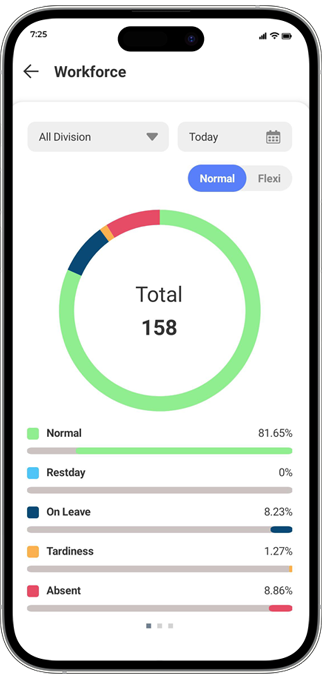
TimeTec Attendance records every clock-in by biometric identity, location, and timestamp, available for the six-year retention period required under Section 61(2), and consolidated across every site the company operates rather than scattered across branch logbooks. The same record set produces the OT register JTKSM asks for, the contribution-base figure PERKESO and EPF audit, the biometric data JIM cross-references against permits, and the workforce headcount that all five agencies use to triangulate against each other’s findings.
The point is not that the system is unusually powerful. The point is that it answers all five questions from the same underlying employee record, which is what coordinated inspections were specifically designed to test. Companies whose data lives in five separate places are not penalised for not having technology. They are penalised for the inconsistencies between the five answers they give to the five agencies.
The Branch Site Is Where the Raid Lands
the joint operation format extends what those visits can do once they arrive. A branch site that struggled to produce attendance records for a single JTK inspector last year now faces five agencies with five distinct evidentiary expectations.
The remote branch is no longer the lowest-priority site for system deployment. It is the highest-risk one.
The Single-Agency Playbook Is Not the Plan You Need
The labour audit of five years ago was a single inspector from a single department asking a single set of questions. Companies built their compliance routines for exactly that interaction. The labour audit of the last twelve months is a coordinated operation that brings together every regulator with a stake in employment, asks the same employee record set from five different angles, and finds the company that has prepared for one of them and not the other four.

The records that survive the operation are the ones that were built for it before the inspectors arrived.