
Bonus month is the one payroll cycle employees look forward to. The figure lands in the bank, the WhatsApp messages go around, the office mood lifts. For the payroll team running it, that goodwill hides one of the most error-prone payroll runs of the year, because the bonus that takes one minute to add to the system takes four separate statutory calculations to get right, and the team that processes bonus the same way it processes a regular salary will get at least two of the four wrong.
The error is consistent enough that the regulator has already caught it. A regional marketing firm in 2025 was assessed back taxes and penalties exceeding RM100,000 for missing PCB on bonuses paid to foreign employees. The mistake was not exotic. It was the same misconfiguration sitting in most Malaysian payroll systems, exposed only when the audit landed.
This is what one RM10,000 bonus actually looks like, line by line, when the law is applied correctly.
The RM10,000 Bonus, in Real Numbers
Take an employee earning RM6,000 a month basic salary. December comes. The company pays out an RM10,000 year-end bonus. The payroll team needs to determine four things: how much PCB to deduct, how much EPF, how much SOCSO, how much EIS.

EPF: the bonus is treated as wages under the EPF Act 1991. The employee contributes 11% of RM10,000, which is RM1,100. The employer contributes 12% (the rate for salaries above RM5,000), which is RM1,200. The bonus EPF flows the same way the salary EPF does, into the employee’s KWSP account.
SOCSO: the bonus is excluded. The Employees’ Social Security Act 1969 specifically defines “wages” for SOCSO purposes to exclude annual bonus payments. Both employer and employee contribute zero on the bonus.
EIS: the same exclusion applies. Zero on the bonus.
PCB: the bonus triggers the Additional Remuneration formula, which is not the employee’s regular monthly PCB rate. The correct calculation is to compute the projected annual income including the bonus, find the PCB liability on that figure, subtract the PCB liability on the annual income without the bonus, and apply the difference in the month the bonus is paid. The exact PCB figure depends on the employee’s age, marital status, dependants and claimed reliefs, but for an employee with no additional reliefs the Additional Remuneration PCB on an RM10,000 bonus will be materially higher than the flat 11% the bonus attracts for EPF.
That is what the bonus should look like on the payslip.
What Most Companies Actually Put on the Payslip
Three errors account for most of what goes wrong.
SOCSO and EIS deducted from the bonus. This is the most frequent error and quietly the most persistent. A payroll team that has set up the system to treat bonus the same as regular salary will run SOCSO and EIS deductions on the bonus amount when neither should apply at all. The over-deduction per employee is small, but summed across a workforce and across the years it goes unchallenged, it is real money the employee should never have paid, and it is the company’s responsibility to refund once it is found.
Flat monthly PCB rate applied to the bonus. Some payroll teams take the employee’s regular monthly PCB percentage and apply it to the bonus amount, instead of running the Additional Remuneration formula. This usually under-deducts, because the bonus often pushes the employee’s projected annual income into a higher tax bracket that the flat monthly rate does not capture. At year-end, the employee finds out through the Form EA reconciliation that they owe additional tax, and the company explains it was a payroll system limitation.
Non-resident bonus treated as resident bonus. Foreign employees who are non-residents under Malaysian tax rules face a flat 30% PCB on Malaysian-source income. Their bonus is Malaysian-source income. The correct PCB rate on a non-resident’s bonus is 30%, not the Additional Remuneration calculation that resident employees use. We have written before about how foreign worker EPF caught most payroll systems unprepared; non-resident bonus PCB is the same kind of trap one wage type later, and the kind of error the LHDN assessment in the opening was built on.
Where Most Payroll Systems Stop Short
None of these calculations is difficult in itself. The Additional Remuneration formula is published by LHDN. The SOCSO and EIS exclusion is in the Act. The non-resident PCB rate is in the Income Tax Act Schedule. The work is in configuring the payroll system to apply them correctly, every bonus run, for every employee category.
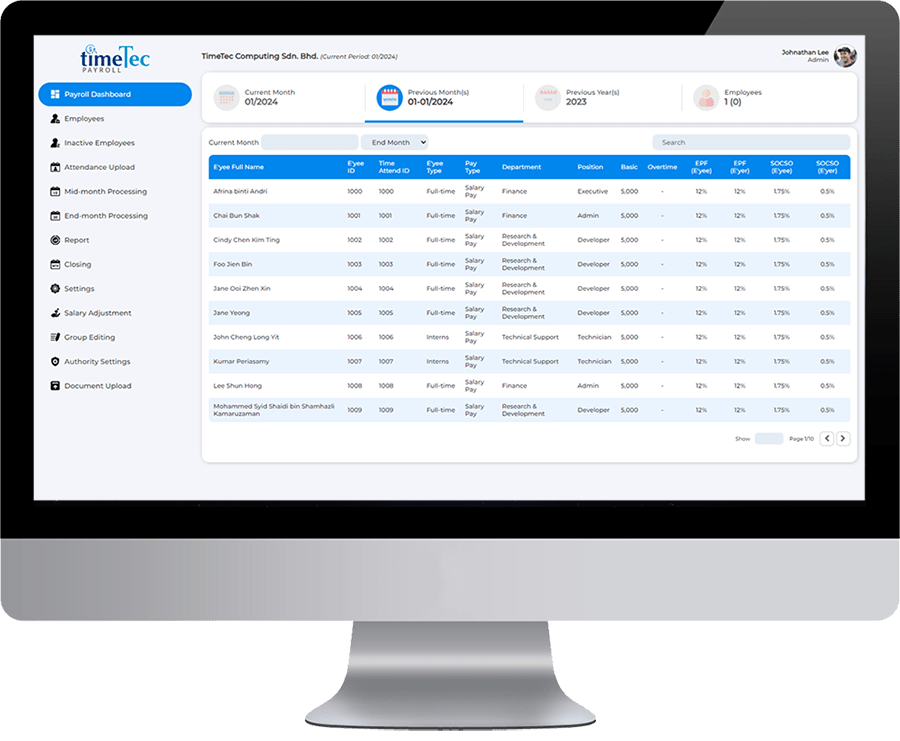
TimeTec Payroll is built to handle regular pay, overtime, bonuses and deductions in the same cycle, with automatic calculations for EPF, SOCSO, EIS, HRDF and income tax running off a single employee record. Because the system is LHDN-approved and HRD Corp-certified, it is configured to follow current Malaysian statutory rules per contribution type. When the bonus is set up with the correct statutory profile inside the system, the payslip and the contribution reports reflect the right treatment for EPF (full inclusion), SOCSO and EIS (excluded), and PCB (Additional Remuneration), without payroll having to override the system in December.
That removes the three errors above, not because the system is more powerful than the payroll team, but because it is not improvising in December what it should have been configured to do in January.
Bonus Month Is Not Where Payroll Gets Easier
The bonus is one entry on the payslip. The statutory layer behind it is four separate calculations governed by four separate definitions of “wages,” and the payroll team that does not see the difference is the same one that pays SOCSO and EIS on bonus, applies the wrong PCB formula, and discovers the error during the Form EA reconciliation in February.
The figure on the payslip looks like a number. The compliance behind it is four.