
Ask Three Departments, Get Three Numbers
A Malaysian SME with around 200 employees recently ran a simple internal exercise. The CEO asked three department heads for the company’s current headcount. Finance reported 198. HR reported 207. Operations reported 192.
Same company, same week, three different numbers.
None of the three was lying. Each was reporting the headcount that mattered to their own function, calculated from the data they had access to. Finance saw the number of employees paid in the last payroll cycle. HR saw the number of active contracts in the employee database. Operations saw the number of people who had actually been on the floor producing work.
The gap between these numbers, fifteen people in this case, is not a rounding error. It is the operational space where ghost employees, terminated-but-not-removed records, employees on extended unpaid leave, contractors miscoded as employees, and statutory submissions misalign with the workforce they are supposed to represent. Every Malaysian company has some version of this gap, and most do not know how big it is until someone asks all three departments the same question on the same day.
Where Each Number Comes From
Each headcount tells a true story about a different slice of reality, and understanding why they differ is the first step to closing the gap.

Finance’s number is the paid headcount. It comes from the payroll register: how many employees received a payslip and a bank transfer in the most recent payroll cycle. It excludes anyone on unpaid leave for the full cycle, anyone whose employment ended mid-cycle and was processed as a final payment in the previous run, and anyone added after the cut-off date for the cycle.
HR’s number is the active headcount. It comes from the Profile module: how many employees have an active employment contract on the system, regardless of whether they were paid this month. It includes employees on long unpaid leave, employees on probation who have not yet hit the first payroll cycle, and any contractor who was added to the system under the wrong employment type. It excludes anyone whose Profile was deactivated, even if they are working their notice period.
Operations’ number is the working headcount. It comes from the attendance system: how many people physically clocked in or recorded work output during the period. It includes contract workers who are part of the daily operation but may not be on the payroll. It excludes employees on leave, employees working from home without clocking in, and employees whose attendance device is broken.
Three different sources, three different methodologies, three different numbers. All three are accurate to what they measure. None of the three is the company’s actual headcount.
What the Gap Hides
The fifteen-person discrepancy in the example above is not just an inconvenience. It hides real operational and compliance risk.
Statutory submission misalignment. EPF, SOCSO, EIS and PCB submissions are made on the basis of paid employees. Form E (the annual employer return) requires the headcount on a specific basis. If the number used in one statutory submission differs from the number used in another, both are technically wrong in some cycle, and the variance is what a regulator’s audit looks for.
Ghost employees and dormant records. An employee who left the company six months ago but whose Profile was never deactivated remains in the system. They cannot be paid (so Finance doesn’t see them) but they appear in HR’s count. The risk: someone with administrative access could re-activate the record, route a payment, and the headcount discrepancy is the only signal anything happened.
Compliance with the 10-employee thresholds. HRDF levy obligation, minimum wage applicability, certain SOCSO categorisations all turn on whether a company has more or fewer than a specific employee count. A company sitting near a threshold needs to know which headcount the regulator will use, and most companies cannot answer.
Budget vs reality. Finance plans next year’s headcount budget based on this year’s paid figure. HR plans next year’s recruitment plan based on this year’s active figure. Operations plans next year’s capacity based on this year’s working figure. All three plans use different starting numbers, and the budget conversation that follows is built on three inconsistent foundations.
Why a Single Source of Truth Matters
The three headcount numbers exist because the three departments are reading from three different systems, or three different views of the same system that were never reconciled. When the employee record is held in one connected platform, each department can still produce its own report (paid, active, working) but all three reports trace back to the same underlying source.
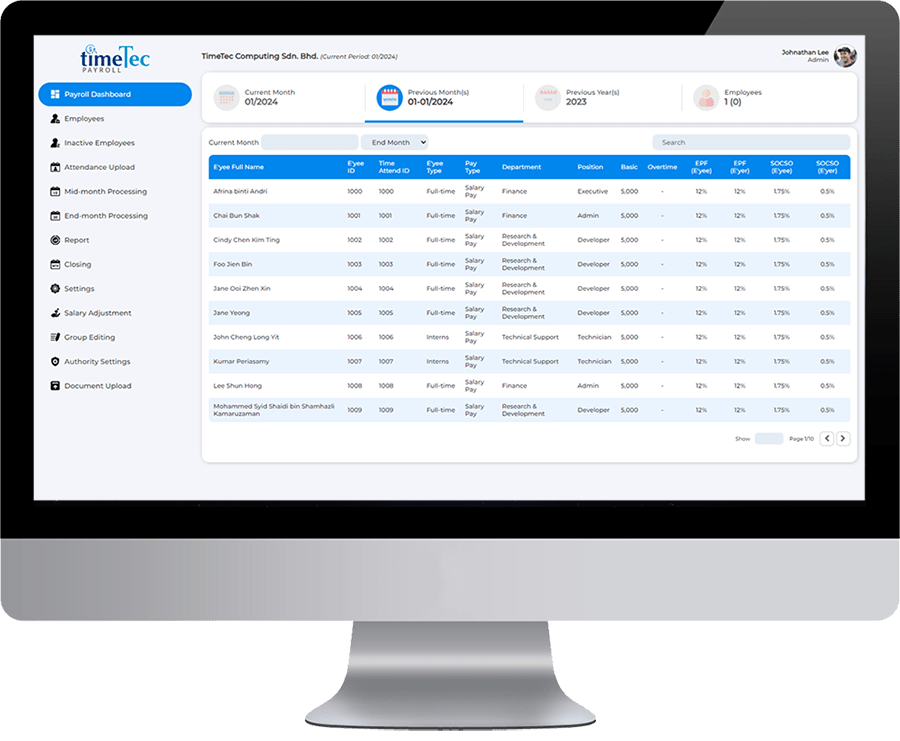
TimeTec HR holds the employee record in the Profile module, with Payroll, Leave, Claim and Attendance all reading from and writing to the same record. The active headcount, the paid headcount and the working headcount remain meaningful as separate metrics, but the gap between them becomes traceable. If Finance and HR’s numbers differ, the system can show why: who is active but unpaid, who is paid but not working, who is working but not on Profile.
The discrepancy does not disappear. It becomes legible. And a discrepancy you can read is a discrepancy you can fix.
The Number That Should Match the Question
The question “how many employees does your company have?” is not as simple as it sounds. The correct answer depends on what the asker means: paid this month, contracted right now, or working this week. Each answer is valid in its own context, and a company that runs all three on the same data foundation can give the right answer to whichever version of the question gets asked.
The company that cannot is a company where Finance, HR and Operations are running three different headcount narratives in parallel. The CEO who asks all three on the same day finds out which one is closest to the truth. The audit that asks the same question on a different day finds out which one was wrong.