A resident pre-registers a guest for 8pm. The guest arrives, and the guard will not lift the barrier. There was an issue with this man the last time he came, the guard says — he was rude at the counter, he would not hand over his IC, and management has told the guardhouse not to let him in again. The resident, standing in the driveway, says the obvious thing: this is my guest, coming to my unit, and you cannot stop him.
Both of them believe they are right, and on Monday morning the committee has to decide which of them actually is. That decision rarely turns on the visitor’s behaviour. It turns on whether the community can produce, in writing, the basis on which it said no.
Can condo management refuse entry to visitors a resident has invited?
Section 21 of the Strata Management Act 2013 gives the JMB — and Section 59 the MC — the duty to properly maintain and manage the common property, security included. That is a duty to manage access. It is not a general power to decide who may enter a private home.
The distinction matters because an invited guest does not arrive as a member of the public asking a favour. They arrive as the resident’s licensee, and a parcel owner’s enjoyment of their parcel includes receiving people in it. When management bodies began barring entry outright during the pandemic, the Malaysian Bar’s position was that the SMA contains no provision permitting it, citing Article 13(1) of the Federal Constitution — no person shall be deprived of property save in accordance with law.
Management therefore regulates the manner of entry — registration, identification, a pass, host confirmation — rather than the fact of the guest. And a rule only binds if it was made properly. The Third Schedule by-laws apply automatically; anything beyond them is an additional by-law needing a special resolution of 75% of those voting at a general meeting and filing with the COB. A committee instruction relayed to the guardhouse by WhatsApp is not a by-law.
The reasons given at the barrier, and whether they hold
| What the guard says | Does it hold? |
|---|---|
| “He vandalised the lift the last time he came.” | Yes — if there is a recorded incident and a documented decision to block that individual. No, if it is one guard’s recollection. |
| “He was rude and refused to register last time.” | Past behaviour alone is weak. Refusing to register at this entry, where a filed by-law requires registration, is defensible on its own. |
| “Your unit is in arrears.” | Weakest of all. The guest owes the community nothing, and refusing them is pressure applied to a third party. |
| “No visitors after 10pm.” | Only if passed as an additional by-law and filed. Otherwise it is a preference, not a rule. |
| “He is not on any list.” | The resident pre-registered him. The list was the process, and it was followed. |
| “He is a contractor with no approved permit.” | Yes — scope, dates, and approval status are documented facts the office can produce. |
Read down the second column and the pattern is hard to miss. The same sentence — this person caused a problem before — is a lawful refusal when the community recorded the incident and made a decision about it, and an unlawful one when it lives in a guard’s memory. The behaviour is identical. The paperwork is what differs.
The arrears case deserves its own line, because it is the one committees are most tempted by and least able to defend. We have set out the competing rights in the evolution of access control in Malaysian property management, and turning a guest away to collect an owner’s debt is the weakest form of that argument.
Why the guardhouse cannot carry this decision
Everything in the right-hand column above requires information the guard does not have at 8pm. Was there an incident report, or just an argument someone remembers? Was this individual formally blocked, and by whom? Is the renovation permit valid this week? Security postings turn over constantly, and the community’s memory sits in the management office during office hours — which is never when the difficult arrival happens.
So the guard guesses. He refuses someone he should have admitted and the committee gets a complaint letter, or he admits someone who should have been stopped and the community finds out after the fact. Both come from the same cause: a decision that was never the guard’s to make.
Making a refusal something the committee can defend
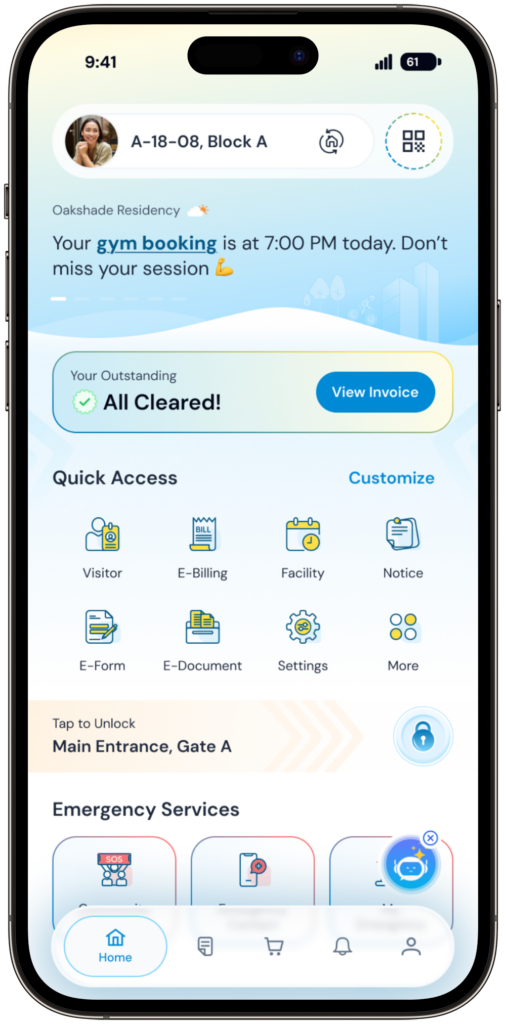
The workable position is that the community decides in advance, and the guardhouse executes. In iNeighbour, a block is held on the visitor profile — by identification number, face, or vehicle plate — with the reason and the incident history attached to it. When that person is scanned at any gate, the guard sees a Restricted or Security Risk flag raised by the office rather than making a character assessment in the driveway. The refusal becomes the enforcement of a recorded decision, which is exactly what a committee needs when the resident escalates.
Flow Builder handles the grounds that depend on status rather than identity. A contractor flow can require an approved E-Form permit and check the arrival against approved dates. A guest flow can require host confirmation. Riders move through a flow built for volume instead of being screened like strangers. And because the by-law behind each rule can be published through the Notice module with acknowledgement tracking, the committee can show the rule existed, was communicated, and was applied to everyone.