
Every Friday evening a different couple arrives at unit 12-3 with cabin luggage. By Sunday night they are gone. Residents have been complaining for months, someone has circulated a screenshot of the listing in the owners’ group, and the committee finally sends a letter. The owner replies within a day: those were his cousins, then his colleagues, then friends from Singapore. He asks what evidence the JMB believes it has.
That reply ends most of these cases. Not because the committee is wrong, and not because the by-law is unclear, but because everything the community holds is a suspicion, and the one thing it needs is a record.
Why a screenshot cannot prove a unit is being rented on Airbnb
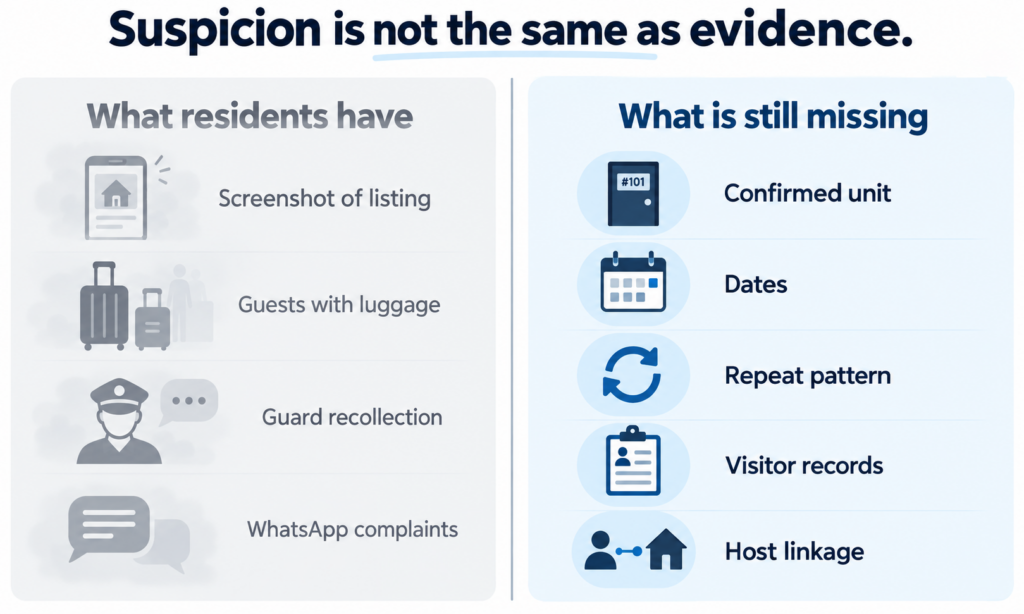
Short-term listing platforms deliberately withhold the exact address until a booking is confirmed. What the screenshot shows is an interior, a view, a first name, and a neighbourhood — all of which the owner can attribute to any of the four hundred units in the development, or to a different building altogether. The listing can also be taken down within an hour of the letter arriving, and a screenshot carries no provenance that will survive a challenge months later.
The screenshot proves that someone is letting short-term. It does not prove which parcel, which owner, or when.
Guard observations fail for related reasons. Strangers with luggage also describes visiting relatives. The guard who noticed has since moved to another site. Nothing was written down at the time, and a recollection reconstructed at a hearing is not evidence of a pattern — it is one person’s memory of a Friday.
The pattern is the evidence, not the incident
One unfamiliar guest is a visit. The same unit receiving a different set of names every weekend, for two nights, forty times a year, is a commercial operation — and that shape is what a committee can actually stand behind. The signature is specific:
- Many visitors, each appearing once, all hosted by the same unit
- Visit durations clustering at two to three nights rather than a few hours
- Arrivals concentrated on Fridays and the eve of public holidays
- No tenancy record on file, while the unit’s occupancy behaves like constant turnover
- Repeated invitation links generated by one unit for people who never return
- Visitors self-registering at the gate and naming that unit as host
No single line above proves anything. Together, and dated, they describe a business.
What your system already recorded
The awkward truth for most committees is that this evidence was being generated all along and nobody looked at it. Communities running iNeighbour hold it inside the modules they already use for daily access control.
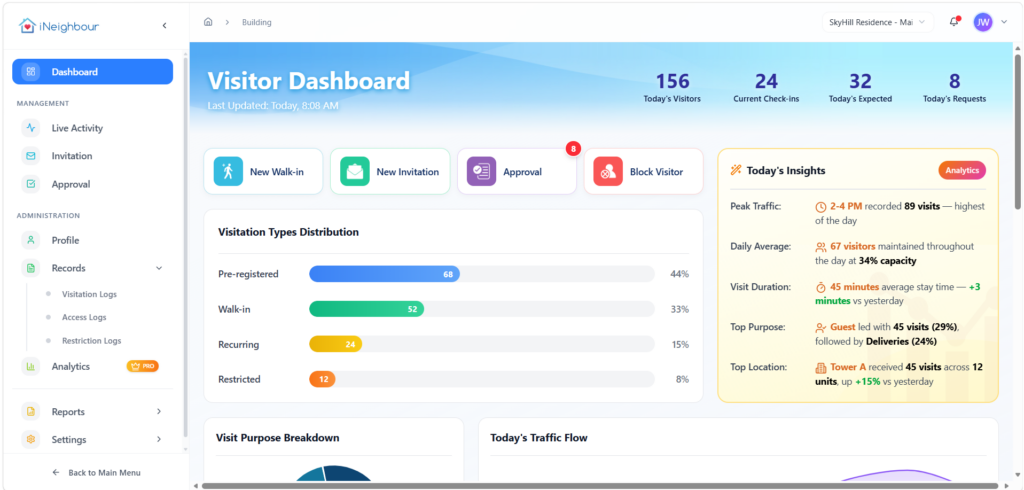
Visitor Analytics reports top hosts, average visit duration, and weekly comparison charts with hourly heatmaps — which is precisely the view that separates a unit with an active family from a unit running weekend turnover. Visitor Profiles hold the other half: a profile accumulates visit statistics and history per visitor, so a unit whose guests each appear exactly once looks nothing like a unit whose regular visitors return. Invitation Management shows how often that unit generated shareable invitation links and to whom, with each invitation tracked across its lifecycle from Expected to Checked-out.
The Lease module closes the gap between what is declared and what is happening. A unit with no tenancy record and an occupancy status of Owner, receiving forty distinct short-stay visitors in a year, presents a contradiction the owner has to explain rather than one the committee has to prove. Every one of these views exports, with activity logs behind them, which is what turns a complaint into a submission.
One further point matters for the committee’s own protection: sensitive visitor fields are masked by default and access is governed by role-based permissions, so the enforcement file is assembled from records the community was already entitled to keep, not from surveillance improvised for the occasion.
The lines a committee cannot cross
The JMB manages common property. It has no right to enter the parcel to inspect it, no power to cut utilities or bar the owner’s own access, and no basis to turn guests away without a documented ground. Booking the unit is the one tactic that produces address-level confirmation, and it is worth doing through the management on legal advice rather than by a committee member acting alone.
Once the pattern is documented, the escalation is ordinary: a notice citing the registered by-law, issued through a system that records view and acknowledgement timestamps, then a charge for the breach, then the COB and the Strata Management Tribunal if it goes that far. Whether short-term letting is permitted at all is a separate question that the community settles for itself — we set out both sides in the short-term rental question in strata — but a ban the community cannot evidence is a ban in name only.