
The complaints tend to arrive in the same order. A maintenance fee notice goes out two days late. A renovation form sits unprocessed for a week. A resident’s email gets no reply until the third follow-up. The committee draws the obvious conclusion — the management office is slow — and the discussion turns to whether AI property management system is what a JMB needs to speed the office up. That is the wrong diagnosis applied to a real problem.
Most strata management offices are not underperforming. They are understaffed relative to the volume of output residents now expect. Two or three administrators are producing the documentation, communication, and follow-up of a team twice their size. The effort is there. The hours are not.
The Real Reason a JMB Looks at AI Property Management System
Residents expect responsiveness that scales with the size of the development, but the office does not grow at the same rate. A 500-unit condominium and a 150-unit one are often run by the same two-person team. What breaks is never the intent — it is the manual production of routine work that has to happen before anything reaches a resident.
Three tasks quietly consume most of a small office’s day, and none of them are the work residents actually see.
Where the Hours Actually Go
The first is notices. A fee revision, an AGM announcement, a water disruption advisory — each needs to be written, formatted into something that reads as official, and sent to the right group. Producing one professional notice from a blank page can take half a day when the office is also fielding walk-ins and phone calls.
The second is forms. Renovation applications, move-in and move-out requests, complaint submissions — each one is created, handed out, collected, and chased by hand. Tracked across email threads and paper trays, a request that’s waiting on a contractor looks no different from one that’s been forgotten, and the office only finds out which is which when a resident follows up.
The third is approvals. When sign-off runs through a single level or, worse, a physical document walked from desk to desk, every approval becomes a manual errand. Nothing shows the committee what is stuck or who is holding it.
Removing the Work, Not Adding the Headcount
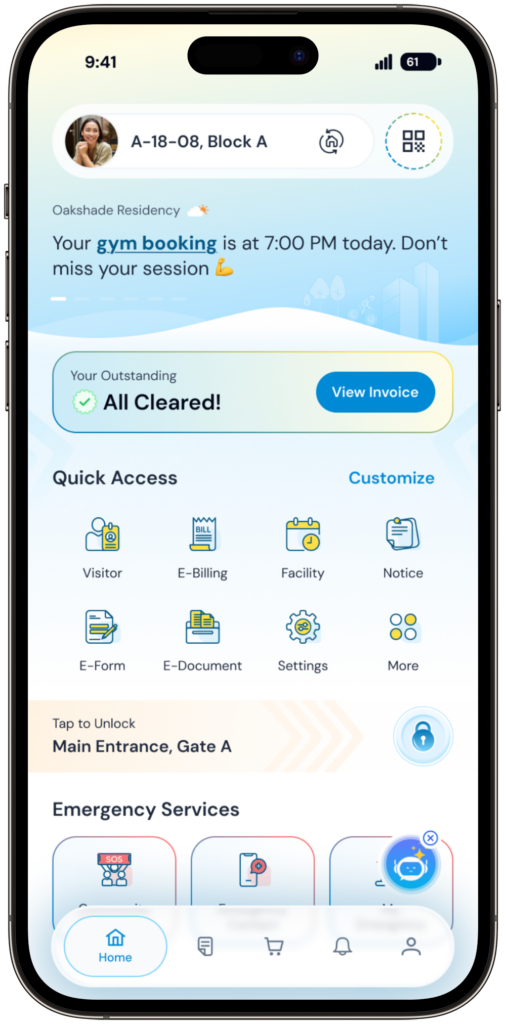
This is where iNeighbour changes the equation — not by making staff work faster, but by removing the production load from their day.
For notices, the AI assistant drafts the content from a short prompt and can generate a formatted letter that is automatically saved as an attachment to the notice. It also offers recipient targeting suggestions. The office still reviews, edits, and decides when to send — the judgement stays with the administrator — but the half-day of writing and formatting collapses into minutes. The decision is human; the typing is not.
For forms, the AI generates form structures from a prompt, suggests conditional logic, and recommends recipient groups, while default templates cover the common cases so nothing is built from scratch. The recommendations are suggestions the admin confirms, not actions the system takes on its own.
The routing load is handled separately by configuration, not by AI. Multi-level approval, set up once to mirror the committee’s actual sign-off chain, replaces single-level approval and the walking-it-around that comes with it. The In Progress / KIV status gives the office a visible place to park a form that is genuinely waiting on something, so a delayed item is no longer indistinguishable from a forgotten one.
And because notices now carry view counts, first and last view timestamps, and acknowledgement tracking, the office stops re-sending and re-chasing. It can see who has read what — which removes an entire category of repeat work.
A System Problem, Not a Hiring Problem
The instinct when an office falls behind is to add an administrator. That scales cost in a straight line and rebuilds the same dependency on one person’s memory. Removing the work between the steps does the opposite — the same team absorbs a larger community without a proportional rise in headcount. We made the financial version of this case in The Real Cost of Manual Property Management Is Hiding in Your Payroll; the operational version is simpler still. The bottleneck was never the people. It was the manual production sitting between every task and the resident waiting on it.