
The dispute never happens on handover day. It happens weeks later, when the first utility bill lands and a buyer picks up the phone insisting the charge is wrong — the meter must have already been running when they collected the keys, they say, or the figure is simply too high for a unit they have barely lived in. The management office goes to defend the bill, and the entire argument comes down to one thing: the handover meter reading. A number a staff member wrote on a clipboard during a busy handover, transferred into billing sometime afterward, with nothing to confirm what the meter actually showed the moment the keys changed hands.
That number is the baseline for every bill that unit will ever receive. It is also, on most projects, the least protected piece of data in the entire handover.
Why the Handover Meter Reading Is the Weak Point
Water and electricity readings are treated as a formality at vacant possession — a box to tick before moving on to signatures and keys. But the opening reading is not a formality. It is the zero point every future consumption charge is measured against. Get it wrong, or lose the ability to prove it, and every bill built on top of it is exposed.
Manual capture makes all three failure modes likely at once. The reading is written down at the busiest moment of the day, so transcription errors slip in. It is re-keyed into billing later, opening a second chance for error and a gap where the number can be lost entirely. And it carries no timestamp and no link to the unit that would let anyone confirm it after the fact. When a buyer challenges the first bill, the office is defending a figure it cannot actually stand behind.
Capture the Reading at the Moment of Handover
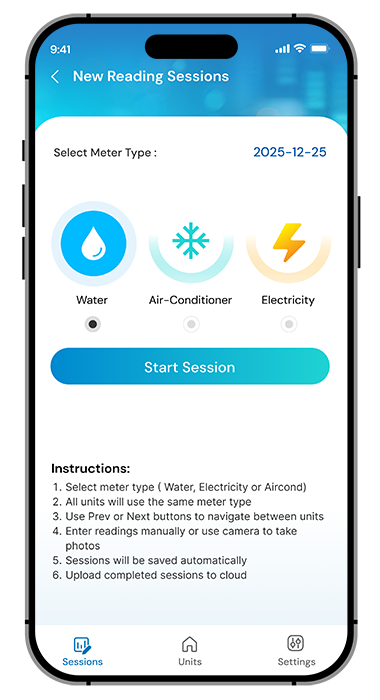
The fix is to record the reading where and when it is taken, not to write it down and re-enter it later. When meter capture is part of the vacant possession appointment, water and electricity readings are recorded in the app at the exact moment of handover and tied directly to the unit’s record.
This is where TimeTec Meter captures the opening reading as a documented step in the handover rather than a note on a form. The reading is timestamped against the appointment and attached to the correct unit from the first second of occupancy — so if the first bill is ever questioned, the answer is a recorded reading tied to the handover, not a staff member’s recollection of a clipboard. On developments with sub-metering across water, electricity, and air-conditioning, each meter is captured against the unit the same way, so nothing depends on which staff member ran which handover.
From Reading to Billing Without the Gap
Capturing the reading cleanly only matters if it reaches billing cleanly. The recurring version of this exact problem — readings taken correctly but stranded in a spreadsheet before they reach the accounts — is one we covered in Why Your Utility Readings Never Make It to Billing Clean. The handover reading has the same journey and the same risk.
When the opening reading is captured in the app and tied to the unit, it flows toward billing in i-Account instead of waiting to be manually transferred. There is no second entry point, no re-keying, and no window where the number gets mistyped or lost between the handover counter and the accounts.
| Reading on paper | Reading captured in the app |
|---|---|
| Written on a form during a busy handover | Recorded in the app at the moment of handover |
| Re-keyed into billing later | Tied to the unit, flows toward i-Account |
| No timestamp, no link to the unit | Timestamped and attached to the correct unit |
| Indefensible when the first bill is disputed | A recorded reading you can stand behind |
What VP-Day Capture Actually Changes
The payoff shows up long after the developer has moved on. The first bill becomes defensible, because there is a recorded opening reading behind it. Opening-reading disputes stop being a judgment call and become a matter of record. And when the development is handed to the incoming JMB, they inherit accurate baselines for every unit rather than a set of numbers no one can vouch for — which is the difference between billing residents with confidence from month one and spending the first quarter fielding disputes over figures the previous team can no longer explain.
A reading on a clipboard tells you someone looked at the meter. A reading captured at handover tells you what the meter showed, on which unit, at the moment the keys changed hands.