
The Condominium Pet Registration Gap
Most JMBs and MCs in Malaysia cannot produce a single document listing the pets currently living in their development. When a complaint, a bite, or a missing animal arrives at the management office, the investigation starts from zero because the condominium pet registration record was never built in the first place. The by-laws may be clear. The enforcement chain is broken at the most basic step, which is knowing what pets exist and where.
Pet ownership has grown steadily across Malaysian high-rise communities over the past decade. Yet pet record-keeping in most developments has not moved past verbal acknowledgements at the management office and a few signed letters filed in a cabinet. The result is that nearly every pet-related dispute begins with a question the committee cannot answer.
Why Verbal Pet Approvals Fail Every Audit and Every Dispute
By-laws passed under the Strata Management Act 2013 are enforceable, but only when supported by evidence. A management office assistant remembering that “the owner of A-12-3 mentioned a small dog two years ago” does not survive a bite incident, an insurance investigation, or a council inspection. Nor does it survive a committee handover. The outgoing chair leaves, the institutional memory leaves with them, and the new committee has no basis to enforce decisions made before their term.
Verbal approvals also create unequal enforcement. Two residents who informally declared similar pets may receive different treatment depending on who in the office handled the conversation. Without a written record, committees defending their actions in front of residents always lose the argument.
What a Proper Pet Record Should Capture
A pet record is operationally useful when it answers, in one place, the questions a committee actually gets asked during an incident. Inside iNeighbour, pet registration sits within the unit record itself.
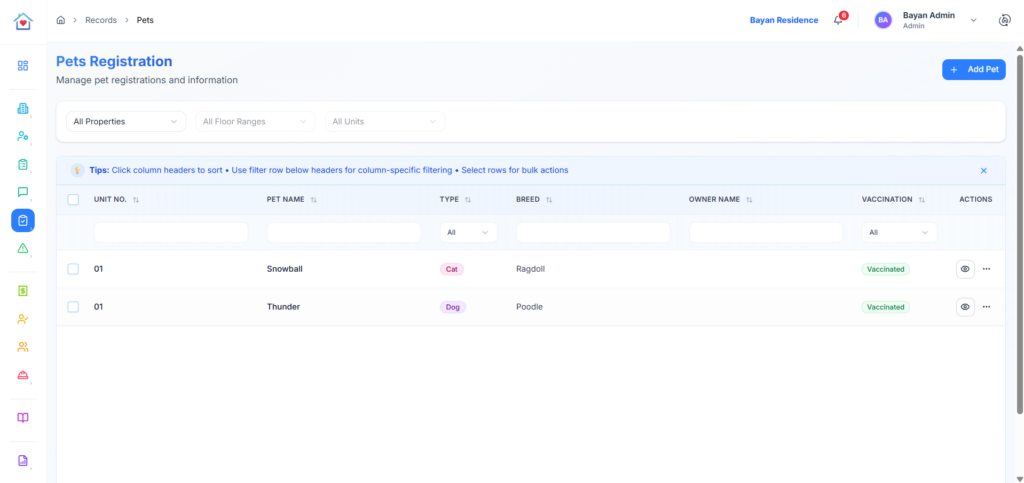
Each pet entry captures:
- Unit assignment, anchoring the pet to a responsible owner
- Pet name, type, breed, color, weight, and gender for physical identification
- Microchip ID, which is often the only piece of information that survives a lost-pet scenario or a disputed ownership claim
- Vaccination status, with the certificate uploaded as a supporting document
- Pet photos for visual matching during a roaming, lost, or incident event
- Attachments for pet licenses, vet records, and breed registration documents
- Remarks for temperament notes, handling instructions, or behavioral flags the guardhouse should know
This is the level of detail that lets a record do real operational work. A pet name and a unit number are not enough. A microchip ID, a clear photo, and a declared breed are.
Where the Record Pays for Itself in a Single Incident
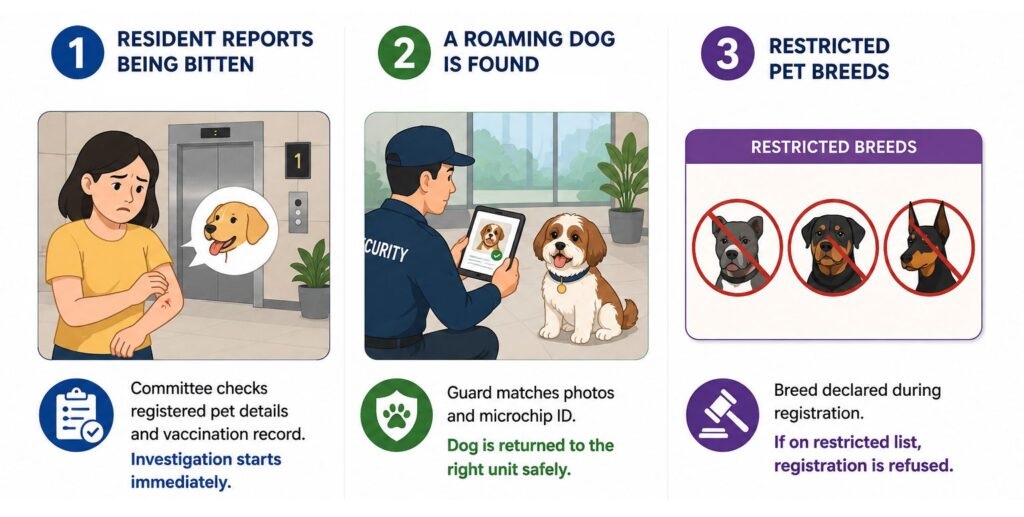
A resident reports being bitten in the lift lobby. The committee opens the unit page, sees the registered pet, the breed, the weight, the vaccination record, and the remarks. The investigation has a starting point within minutes instead of waiting for a written complaint chain to develop.
A roaming dog is found in the lower lobby. The guard checks the photos against registered pets, matches the microchip ID, and returns it to the correct unit before it leaves the development or harms a child.
A by-law restricting specific breeds is finally workable. The committee no longer needs to prove what breed a dog is, because the resident’s own registration declares it. If the declared breed appears on the restricted list, the registration can be refused outright. If the declared breed and the visible animal do not match, the resident’s signed declaration is the evidence on which the committee acts.
In each case, the record carries the weight that committee memory cannot.
How Pet Records Sit Inside the Wider Unit Record
The reason this works is structural. Pets register against the same unit that holds vehicle records, occupancy data, tenancy details, and unit documents. One unit lookup answers everything about an address. This is the same logic we covered in Why Your Condo’s Vehicle Records Are Already Wrong, where unit-level records stay current by design because the data ties to the address, not to a separate departmental list nobody remembers to update.
When ownership changes or tenants leave, the pet record moves with the unit and the user history. New tenants entering the unit are prompted to declare their own pets as part of the move-in workflow, which means the record refreshes naturally as the community changes around it.
What Pet Registration Cannot Do, and Why That Is Still Enough
Honesty matters. Pet registration does not stop residents from keeping unregistered pets. It does not auto-detect new arrivals. It does not enforce by-laws on its own.
What it does is end the state where the committee has no record at all, which is the precondition for everything else. Without a record, no by-law can be enforced, no incident can be investigated, no insurance claim can be substantiated, and no committee handover can transfer pet-related decisions to the next term. Registration is the foundation. Enforcement actions and policy refinement are built on top of it.
Communities that wait to fix pet issues after a serious incident often learn the same lesson too late. The time to build proper records is before they are needed, not after something happens.
A complaint log tells you who is unhappy. A pet record tells you whose pet caused it.