
The keys are ready. The unit has passed inspection, the buyer has booked their slot, and the handover team is set. Then the buyer reaches the payment counter. Advance maintenance fee collection — along with the sinking fund contribution and deposits every purchaser is told to settle before taking vacant possession — turns into the step that stalls everything. Cheques are handed over and set aside to clear. Transfer slips are held up to be verified against a bank app. Receipts are written by hand. The queue that was moving through inspection now backs up at the one desk where money changes hands.
The payment was never the problem. The counter is.
Advance Maintenance Fee Collection Was Always Going to Happen
Let us be clear about what is not in dispute. The advance maintenance fee is a precondition of handover. Buyers know they owe it, they expect to pay it, and no reasonable purchaser arrives expecting to collect keys without settling. This is not a collection problem in the sense of chasing reluctant payers.
It is a processing problem. When a mandatory payment is collected manually at the point of handover, three things go wrong at once. Cheques introduce a clearance delay, so either keys are released against uncleared funds or the buyer is turned away and asked to come back. Bank transfers have to be verified one by one against a slip or a phone screen, which is slow and error-prone under a queue. And every payment taken on the day still has to be reconciled and posted into the accounts afterward — a second round of manual work that the finance team absorbs long after the handover crowd has gone home.
The money arrives. It just arrives in the most labour-intensive way possible, at the worst possible moment.
Move the Payment Ahead of the Appointment
The fix is to stop treating payment as a handover-day event. When the payment sits inside the appointment workflow, the buyer settles the advance maintenance fee through the app before they arrive. By the time they reach the counter, they are already cleared to collect — there is no cheque to wait on, no slip to verify, no receipt to write.
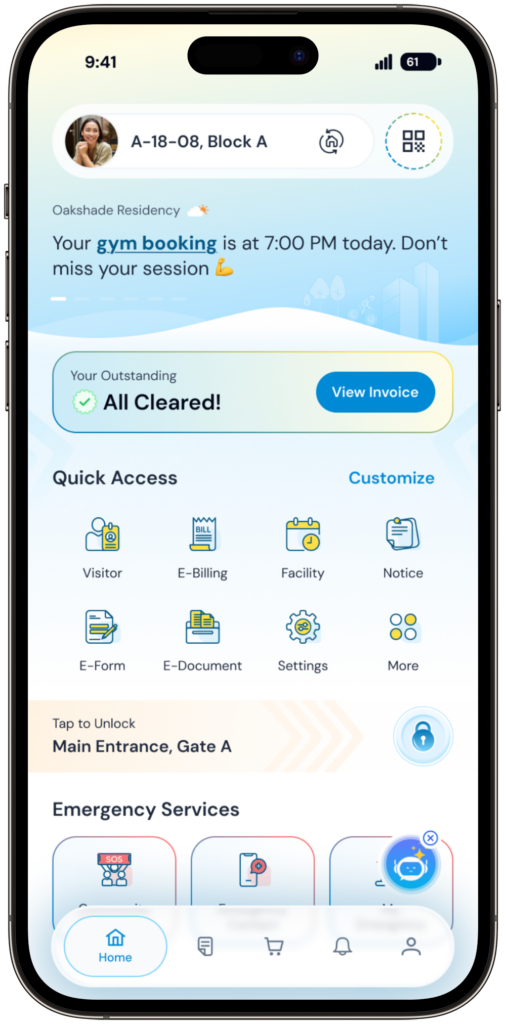
This is where iNeighbour handles the payment as part of the VP appointment rather than as a separate transaction bolted onto the end. The buyer reviews their VP details, pays through the app, and books their slot already settled. The handover team sees who has paid and who has not before the day begins, which means the appointment schedule reflects reality — the people arriving are the people ready to receive keys.
The same friction shows up in recurring collection long after handover, which we covered in Auto Debit for Residential Maintenance Fees — the pattern is identical: payment fails not because residents refuse, but because the process makes paying harder than it needs to be.
Payment That Posts Itself
Removing the counter queue is only half the gain. The other half is what happens to the record. When payment runs through the app, it posts automatically to i-Account against the correct unit — no re-keying, no month-end reconciliation of a stack of handover-day cheques.
That matters most for what comes next. Vacant possession is the moment the community’s financial records are created, and a development that starts with clean, posted opening balances hands the incoming JMB a working ledger instead of a backlog. (Advance maintenance fee collection through the app requires an i-Account subscription for the accounting integration.)
| Manual payment at handover | Payment through the app |
|---|---|
| Buyer pays by cheque or transfer at the counter | Buyer settles in the app before arriving |
| Cheque clearance delays key release | Buyer arrives already cleared to collect |
| Slips verified one by one under a queue | Payment status visible before the day starts |
| Reconciled and posted to accounts later, by hand | Posts automatically to i-Account against the unit |
What This Changes on Handover Day
The handover stops carrying a payment counter at all. The team runs inspections and key release without a finance bottleneck in the middle of it, buyers are not turned away over an uncleared cheque, and the finance team is not reconstructing a day’s worth of payments the following week. The money side of vacant possession is closed before the buyer walks in.