Most developments spend their visitor management budget on two things: the app residents use and the policy the committee approves. Both eventually arrive at the same place — the gate, where the system depends entirely on whoever is on shift that night. The hard part of guardhouse visitor management is not the technology or the rules. It is that the person enforcing them often started this week and carries none of what the community has already learned about its own visitors.
That is not a criticism of guards. It is a description of the job.
The memory problem in guardhouse visitor management
A management office gets smarter over time. It learns which contractors overstay their scope, which visitors caused an incident and were barred, which units generate repeat disputes. That knowledge accumulates in the office.
It does not accumulate at the gate.
Security postings turn over frequently, and at many developments the guards are supplied by an outsourced firm that rotates personnel across multiple sites. A guard three days into a posting cannot be expected to know a ban issued three months ago, or recognize a plate that has been a problem all year. There is no handover document that carries that history shift to shift. So the gate resets to zero every time the roster changes — and the barrier goes up on instinct rather than on record.
The community’s memory and the gate’s memory are two different things. And the gate runs on the one that keeps getting wiped.
The guard is set up to fail, not failing
When a banned visitor is allowed entry, the guard is often blamed. However, if the guard joined after the ban was issued and was never informed, the real issue is a lack of visibility. Expecting guards to enforce restrictions they have never been made aware of is unrealistic, especially when they are managing a queue of vehicles at the barrier gate.
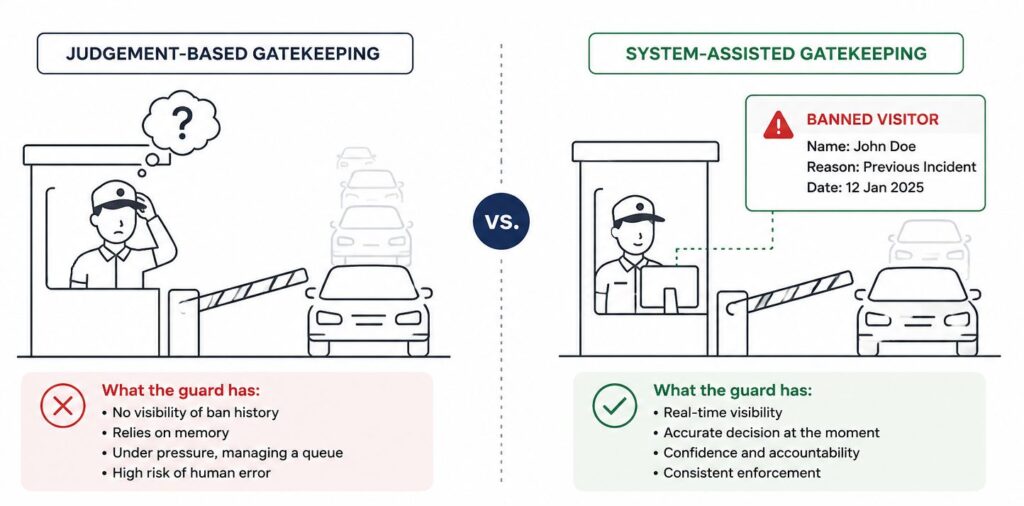
This is the real design flaw in judgment-based gatekeeping: it loads responsibility onto the individual and gives them nothing to make the right call with. The fix is not better guards. It is a system that hands the guard the answer at the moment of decision — so the three-day guard performs like the three-year one.
The safe path has to be the easiest path
There is a failure mode every property manager will recognize. During a rush or a group arrival, a guard lifts the barrier from a host’s list of car plates without logging anyone, because typing each visitor in is slower than the queue demands. The system did not fail. It was bypassed — because using it was harder than skipping it.
This is the bar a real visitor system has to clear. It is not enough to be capable. The standardized, on-record path has to be the path of least resistance for a guard under pressure, or it gets abandoned exactly when it matters most.
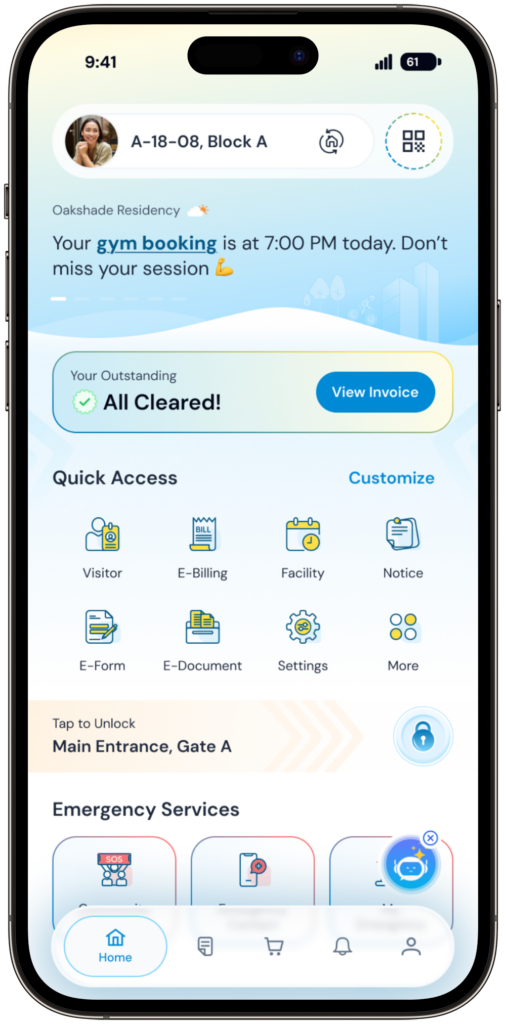
That is where the architecture matters. In iNeighbour, the work is moved off the gate before the visitor arrives. Residents pre-register guests and send shareable invitations, so the visitor is already approved and the guard only confirms arrival. Group invitations consolidate into a single visitation record instead of a guest-by-guest backlog. Visitor profiles flag a barred IC or plate at the moment of scan, surfacing history the guard could not possibly know. Flow Builder enforces the correct sequence per purpose, so a contractor cannot skip the acknowledgement step the way a rushed human might. The guard app, iVizit, becomes an instruction set rather than a memory test.
The record layer underneath this is what makes it work — we made that case in The Visitor Profile Is the Security Layer, where a profile that accumulates across visits is what lets any guard, on any shift, see what the community already knows.
Judgment-based gate vs. system-supported gate
| Scenario | Judgment-based gate | System-supported gate |
|---|---|---|
| Barred visitor returns | Relies on the guard recognizing them | IC or plate flagged automatically at scan |
| Shift handover | History stays with the previous guard | Profiles and flags persist in the system |
| Contractor scope | Guard trusts the visitor’s word | Flow enforces approved purpose and dates |
| Group arrival | Plates waved through off-record | Pre-registered group consolidated in one record |
| After an incident | Manual log, if it was filled in | Timestamped, identity-linked trail |
Why this matters now
Guard-dependent security does not scale. A firm managing several developments cannot rely on each site’s roster holding the right knowledge in the right heads at the right time. And with committees turning over every year or two, the institutional memory of who belongs and who was barred has to live somewhere permanent. The guardhouse is not that place. The system is.
A guard can only act on what they are told. A logbook records who arrived but cannot warn who shouldn’t have. Put the memory in the system, and the gate stops depending on who happens to be standing at it.