
Most developments did not choose a fragmented technology stack. They accumulated one. A visitor app bought the year the guardhouse logbook finally failed. A separate billing tool added when maintenance fee collection got out of hand. Access control bundled in by the hardware vendor. Accounting living in spreadsheets because that is where it has always lived. Each decision was sensible on its own day. The result, years later, is a management office running four or five systems that do not talk to each other — and a clear industry trend now reversing it.
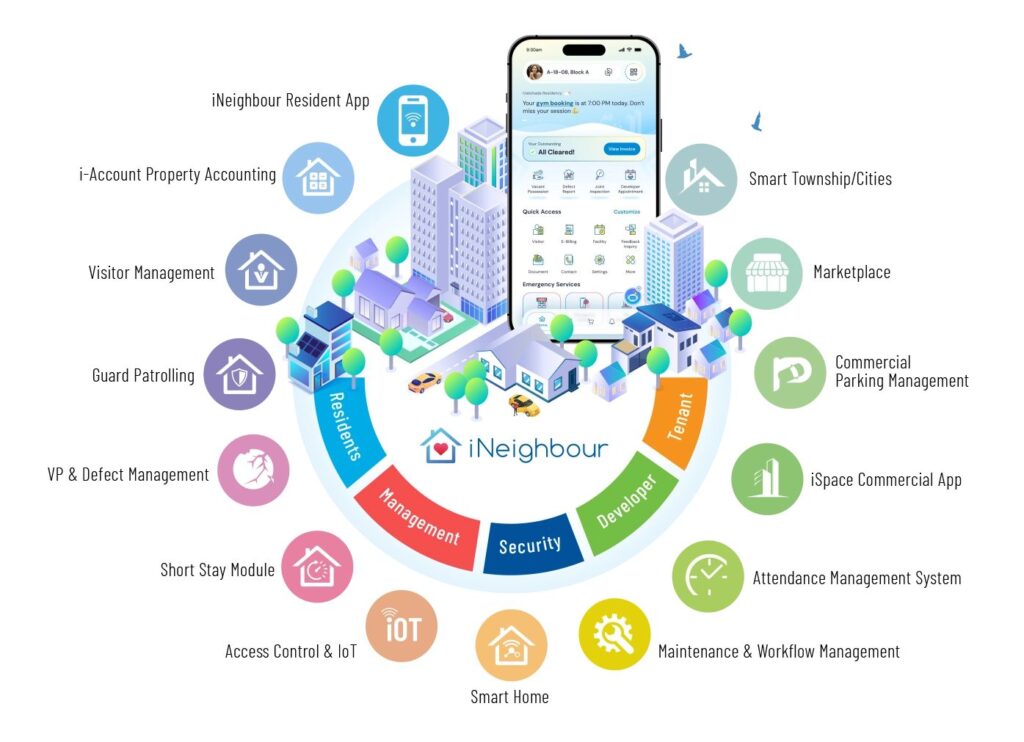
The shift is toward an integrated property management system: a single operational core where one resident record drives visitor approval, billing, access, and tenancy at once. It is the most consequential change in residential property technology right now, and it has almost nothing to do with new features.
Why the standalone era happened — and why it is ending
Every system in a typical development was bought to solve one problem in isolation, in the order those problems became painful. Nobody designed the stack. It assembled itself.
That worked while each tool only had to do its own job. It stops working the moment the jobs overlap — which, in a residential community, is constantly. A new tenant is a tenant record, a billing account, an access credential, and a lease document on the same day. A defaulter is an accounting entry that should also affect parking access. A committee handover is every one of those records changing hands at once.
Standalone systems cannot see across those boundaries. So a person does it instead.
The cost is not the licence fees
When JMBs evaluate consolidation, they look at subscription costs and conclude the fragmented setup is cheaper. The real expense sits somewhere the budget never captures: the manual transfer work between systems.
Consider what fragmentation actually demands of an admin in a single week. A new tenant gets keyed into the visitor system, then again into billing, then again into access control — three entries, three chances for the records to drift apart. Collection figures get exported from the billing tool and reconciled by hand against the accounting ledger. Vehicle records quietly rot because nothing forces re-registration when a tenant changes, and no single system owns the truth.
None of this shows up as a line item. It shows up as headcount. As communities grow, fragmented operations force developments to add admin staff simply to move data between tools — work that produces nothing except the appearance of a functioning system.
What “one core” actually means
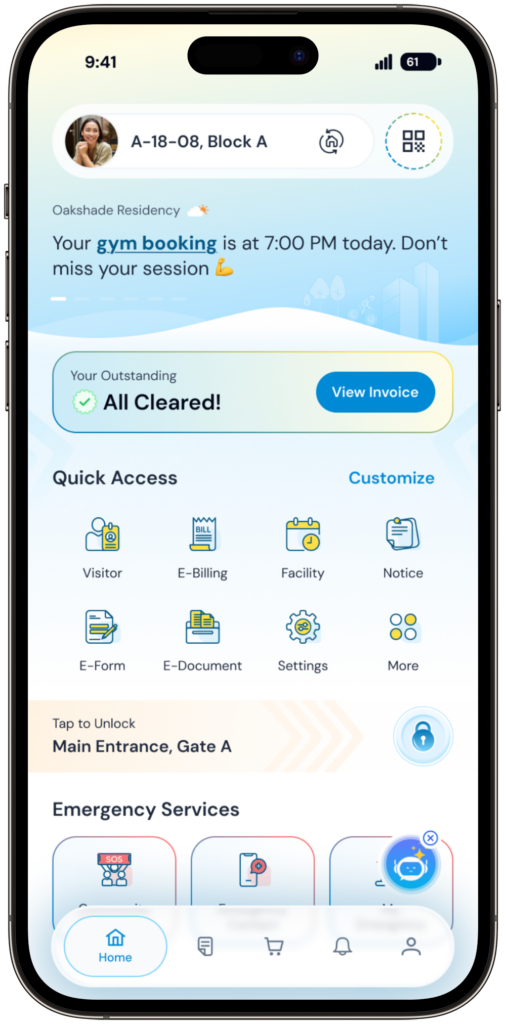
Consolidation is not a bundle of the same separate apps under one invoice. It means the modules share a single source of truth.
A unified platform like iNeighbour is built so that one resident record feeds every function that needs it. Register a resident profile and pair it to visitor module, lease record, billing account, and the access credential. Billing posts to the accounting layer without anyone re-typing a figure. When a record changes, it changes everywhere — because there is only one record.
This is also the practical reason the older argument for integration has matured into a consolidation trend. We made the narrower version of this case in Why Visitor Management Systems Should Be Integrated, Not Standalone — a standalone visitor log is just a logbook replacement until it connects to access. The trend now applies that same logic to the entire stack, not one module.
Why the trend is accelerating now
Three pressures are pushing consolidation from a nice-to-have to a baseline expectation.
The first is portfolio management. Property management companies managing multiple developments cannot log in and out of separate accounts per site or per tool — they need a single switchboard across the entire portfolio.
The second is committee turnover. Strata committees change every twelve to twenty-four months. Institutional memory survives a handover only when records live in one system with permissions and audit trails, not in a departed treasurer’s spreadsheets and a vendor’s standalone dashboard.
The third is the one that will decide the next five years: analytics and AI only work on connected data. Visitor heatmaps, collection trends, occupancy breakdowns, anomaly detection — none of it is possible when the data lives in five systems that never reconcile. A fragmented stack is not just inefficient. It is structurally incapable of becoming intelligent.
That is the real reason the standalone era is closing. The next generation of community management is built on data that flows. Fragmented systems cannot flow — they can only be carried, by hand, by someone, forever.
Integration used to be the upgrade. It is becoming the starting line.