
The Multi-Site Claim That Falls Apart at the Fifth Development
A property management company onboarding its fifth or sixth development usually discovers the same thing: the multi-site property management system they bought is really a single-site product with a dropdown in the header. Each new development gets its own admin accounts to manage, its own permission setup, and its own reporting silo. The promise of one platform for the entire portfolio quietly collapses into ten copies of the same product, each demanding its own administrative effort.
This is the gap that decides whether a managing agent can scale to twenty developments or stalls at six. The vendor’s spec sheet says multi-site. The operational reality says otherwise.
What Real Multi-Site Property Management System Looks Like
Multi-site, as a feature, is table stakes in 2026. Almost every property management system offers it on paper. What separates genuine portfolio architecture from a login switcher comes down to four operational tests. Any operator evaluating a system should run every demo through them.
Test 1: Cross-Site Admin Role Inheritance
In a single-site product with a switcher, every site keeps its own admin database. When a regional manager joins the team, IT creates an account ten times, once per development. When that manager leaves, the same ten accounts have to be deactivated, and almost always one or two are missed.
Real multi-site system treats admin roles as a portfolio resource. A role defined once carries the same permissions across every site the user has access to, with the option to scope access to a subset of sites, a specific module, or a specific approval action. Adding a new development means assigning existing roles, not rebuilding them.
Test 2: Mixed High-Rise and Landed in One Hierarchy
Most portfolios are not uniform. A typical managing agent oversees a mix: high-rise condominiums, serviced apartments, and landed gated communities. A platform that handles one architecture and forces a workaround for the other doubles the operational complexity.
A unified Site, Property, Level or Street, Unit hierarchy is the architectural answer. The same structure serves a 30-storey block with 600 units and a gated landed community with named streets and numbered houses, without splitting the portfolio across two systems or two databases.
Test 3: Consolidated Dashboards a Regional Manager Can Act On
If a regional manager wants to see total outstanding maintenance fees across the portfolio, total active defaulters, pending visitor approvals, or weekly visitor traffic comparisons across sites, the system should produce it in one view. Most multi-site platforms cannot. They produce per-site reports that the manager exports and reconciles in a spreadsheet.
Consolidated reporting is what turns a multi-site claim into portfolio-level management. Without it, leadership is making decisions from spreadsheets, not the system.
How iNeighbour Approaches the Portfolio Layer
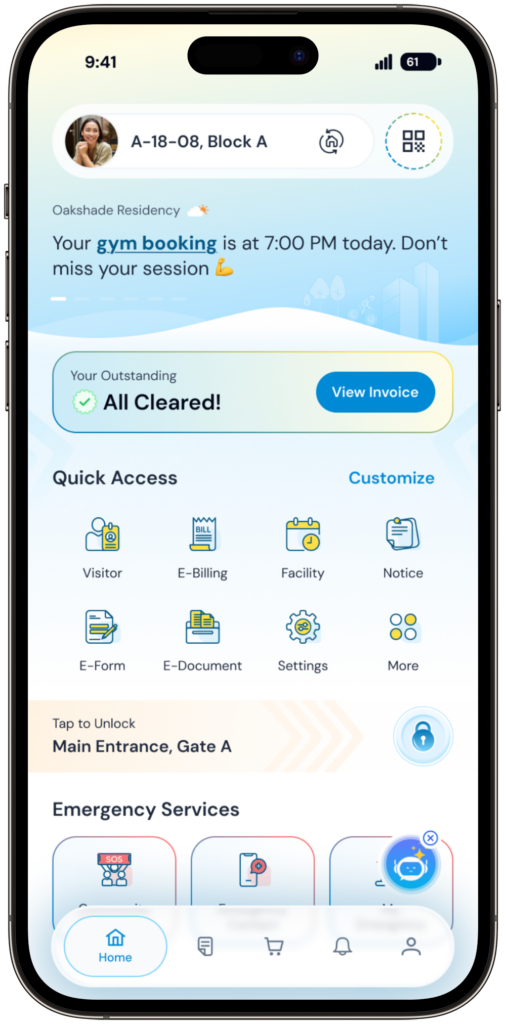
iNeighbour is built around a global site switch bar that operates above the individual site layer. Admins move between developments in one click without logging in and out. User and admin management is centralized, so a regional manager added once is available across every site they have access to. The Site, Property, Level or Street, Unit hierarchy handles high-rise and landed within the same structure, eliminating the dual-system problem.
Dashboards aggregate at the regional level for E-Billing outstanding amounts, defaulter records, and visitor traffic patterns, so leadership can see the whole portfolio in one screen rather than ten.
The portfolio-layer principle is the same one we covered in The JMB Committee Handover Problem: data, roles, and records that exist above the individual unit, site, or committee are what give a property management operation continuity. For an operator running more than five developments, this is the structural difference between a system that scales with the portfolio and one that multiplies administrative load with each new contract.