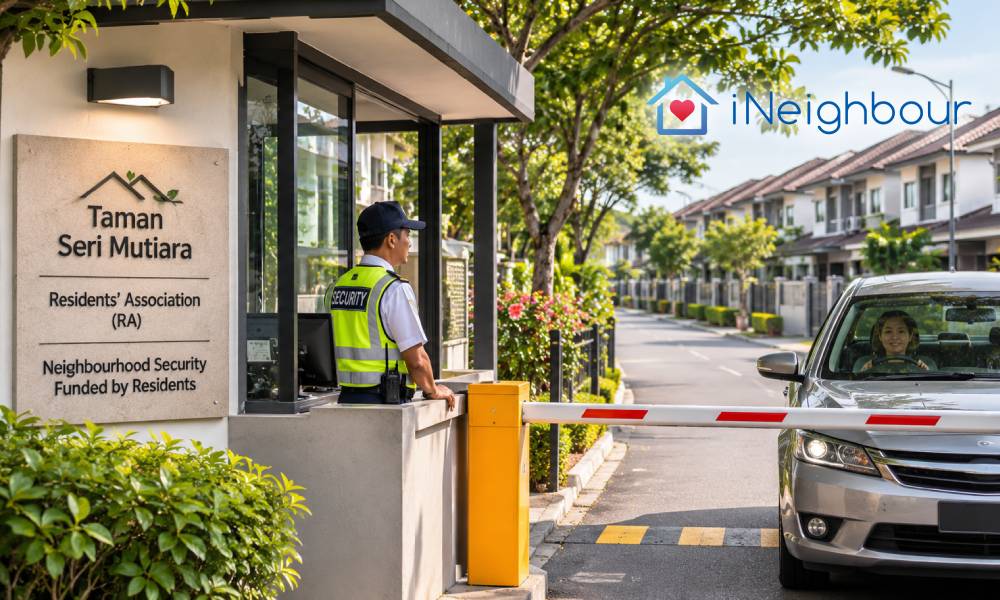
In a condominium, the JMB or MC collects maintenance charges backed by the Strata Management Act. In a landed guarded neighbourhood, the residents’ association (RA) has no such backing. Its guarded neighbourhood security fee depends on households choosing to join the scheme and continuing to support it. Members may have obligations under the association’s own constitution or agreed terms, but the RA cannot impose a statutory charge on every house in the area.
That changes the question an RA committee should be asking. It is not how to make every household pay. It is how to give residents a clear reason to keep contributing.
Why a Guarded Neighbourhood Security Fee Is Not a Maintenance Charge
Gated communities under strata title have a JMB or MC and compulsory charges. Guarded neighbourhoods are different: individually titled houses on public roads, with security organised by an RA.

PLANMalaysia’s 2019 guideline for guarded neighbourhoods sets the national framework. The application goes through an RA registered with the Registrar of Societies, requires the consent of 85% of residents occupying the neighbourhood’s homes, without coercion, and states that households who do not take part cannot be prevented from entering their homes. Local authorities apply their own conditions alongside it. Selangor’s framework, for example, sets 75% consent for a manual boom gate.
Courts have recognised that access procedures can differ. In April 2024, the Federal Court declined to overturn a decision allowing the Parkville RA to require non-paying residents to raise the boom gate themselves, without guard assistance. The case shows that a different procedure may be permissible. However, the ruling does not give RAs unrestricted authority to impose conditions on non-paying households. Residents must still be allowed access to their homes.
Supporting the Scheme Is Not the Same as Funding It
This is a gap RA committees can easily overlook. A neighbourhood can reach the consent threshold to establish a guarded scheme, yet not every household that supported the guardhouse becomes a paying member. Supporting the idea of security and funding its monthly cost are two separate decisions.
Several operational problems then make the scheme harder to sustain:
- Payment runs on bank transfers, cash and screenshots sent to a volunteer treasurer on WhatsApp.
- Residents cannot easily see what the fee pays for — the guard contract, the accounts, or what the guardhouse handled last month.
- The record of who has joined, who has paid and who has stopped lives in a spreadsheet that changes hands with every committee.
Each adds friction and weakens confidence in the scheme, even among residents who are willing to contribute.
How an RA Earns Ongoing Support
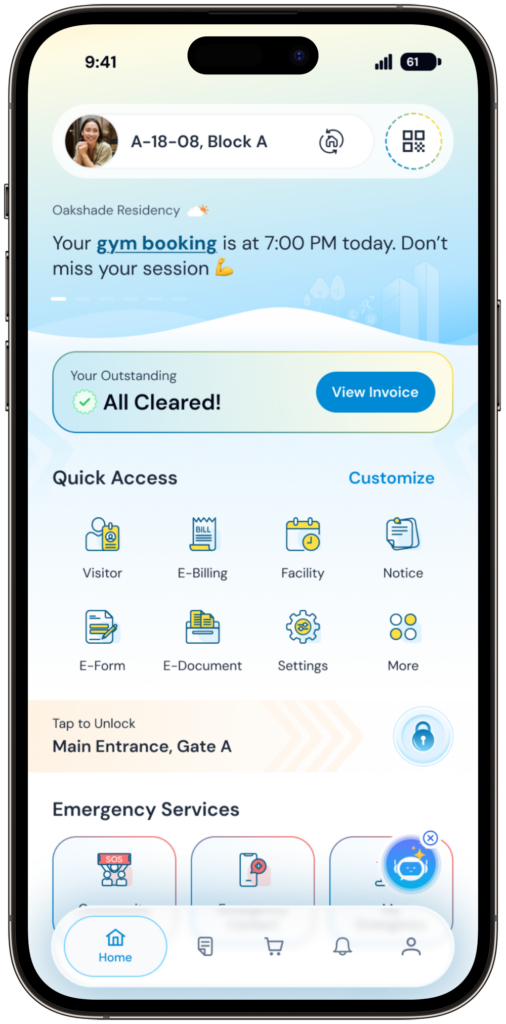
iNeighbour supports landed developments through its Site → Property → Level/Street → Unit structure, so an RA can organise every house by street within one system. From there, the work comes down to three things.
A. Know who is participating
Whatever tools the committee uses, its records should show every house in the neighbourhood and, as a separate list, which households have agreed to contribute and their payment history. Keeping consent to the scheme and agreement to pay as distinct records gives the committee an accurate picture of its funding base, rather than an assumption based on the original consent count.
B. Make contributing easy
For participating households, E-Billing can simplify security fee payments through auto debit and options such as DuitNow QR. Its billing versus collections report also helps the committee monitor payments and reduce manual reconciliation work.
C. Show residents what they are supporting
Transparency is the RA’s strongest argument. The committee can share the security contract and financial statements through E-Document, and publish service updates through Notices, with view and acknowledgement tracking showing who has seen them. Visitor Analytics can also provide insights into guardhouse activity, while financial statements and regular service updates give residents a clearer picture of how their contributions are used.
Beyond fee collection, the RA must also maintain proper visitor records and ensure continuity between committees. iNeighbour supports visitor registration through iVizit, while centralised records, activity logs and role-based permissions help incoming committees continue where their predecessors left off.
Getting residents to agree to security is one challenge. Getting them to continue supporting it is another.