
Employment contract stamping was easy to overlook when the duty was small and the rules rarely featured in day-to-day HR work. A letter of offer could be signed, filed and forgotten. From 1 January 2026, employers need to make employment contract stamping part of the onboarding process, with the applicable treatment depending on the employee’s monthly remuneration. Those contracts fall within Malaysia’s stamp duty requirements, and missing the deadline can cost several times more than the duty itself.
What Actually Changed

Two things changed at the start of 2026. First, stamp duty moved to a self-assessment system (STSDS), handled through e-Duti Setem on the MyTax portal. Under it, you calculate, declare and pay the duty yourself rather than waiting for LHDN to assess each document. Second, the exemption threshold for employment contracts rose, taking the monthly remuneration threshold from RM300 to RM3,000.
That second change matters in both directions. Contracts for employees whose monthly remuneration is RM3,000 or below are exempt from stamp duty and do not need to be stamped or endorsed. Contracts above RM3,000 are subject to stamp duty. Above that line, only the principal employment contract containing the agreed terms and conditions of employment needs to be stamped. One point worth noting: HASiL has indicated that the RM3,000 refers to monthly remuneration, which includes allowances provided by the employer rather than basic salary alone, so a basic wage just under RM3,000 topped up by allowances can still cross the threshold. HASiL confirmed the latest treatment in a media statement dated 7 August 2026.
The Rule at a Glance
| Item | Rule |
|---|---|
| Duty | RM10 per employment contract (flat) |
| Needs stamping | Principal contract where monthly remuneration is above RM3,000 |
| Exempt | Monthly remuneration of RM3,000 or below, no stamping or endorsement |
| Supplementary documents | Documents relating to the same employment arrangement do not need separate stamping or endorsement |
| Deadline | Within 30 days of signing in Malaysia, or within 30 days of receipt in Malaysia if signed abroad |
| How | Self-assessed via e-Duti Setem on MyTax |
That supplementary-document point is worth holding onto. Where the principal employment contract contains the agreed terms and conditions of employment, it is the main contract that needs to be stamped. HASiL’s 7 August 2026 clarification states that supplementary instruments relating to the same employment arrangement do not need to be stamped or endorsed separately.

RM10 Is Not the Number That Hurts
The duty itself is small. The penalty is not. Stamp a contract late and the charge is RM50 or 10% of the duty, whichever is higher, if you stamp within three months of the deadline, rising to RM100 or 20% after that. Because the duty is only RM10, the penalty floor of RM50 is effectively five times the tax, and it applies per contract. Across a year of new hires, a company that never set up a stamping routine is quietly accumulating penalties on every qualifying agreement it signed.
A separate voluntary disclosure programme for older instruments has been extended until 31 December 2026. It applies to eligible instruments executed between 1 January 2023 and 31 December 2025, with late-stamping penalties waived when the programme conditions are met. It does not, however, provide a blanket waiver for late or missed stamping of employment contracts executed in 2026. And it matters beyond the tax: an instrument that has not been duly stamped generally cannot be admitted as evidence until the required duty and any applicable penalty are paid, so the document you most need in a dispute is the one most likely to be unstamped.
Knowing Which Contracts, and By When
The practical difficulty is not paying RM10. It is knowing which of your contracts cross the RM3,000 line and when each one was signed, because the 30-day clock runs from the date of execution for a contract signed in Malaysia, or from the date it is first received in Malaysia if it was signed abroad. A company hiring across the year has dozens of these clocks running at once.
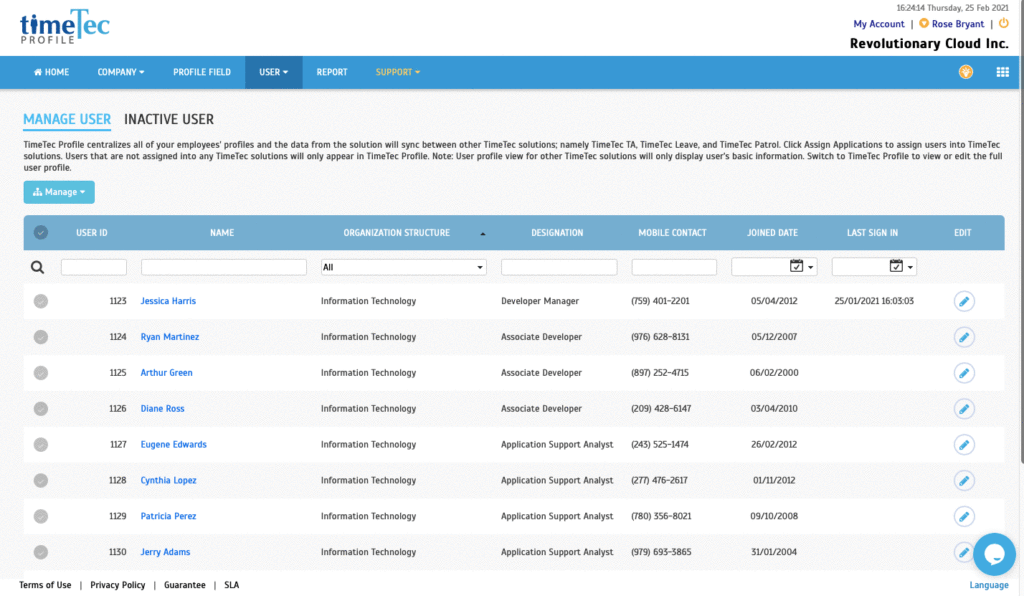
This is where your employee records do the work. With TimeTec HR keeping employee remuneration and employment records in one place, HR teams have clearer information to identify contracts that may cross the threshold and monitor their onboarding timelines, rather than discovering an unstamped backlog at audit time. The stamping itself is a MyTax task, but knowing what needs stamping, and before the deadline, starts with records you can actually read.
The Cheap Tax With the Expensive Habit
Stamp duty on an employment contract may be one of the smallest tax obligations your company handles this year. The risk was never the RM10. It is treating a RM10 obligation as too small to set up a process for, and letting the penalties and unstamped contracts pile up where you will only find them when they matter.