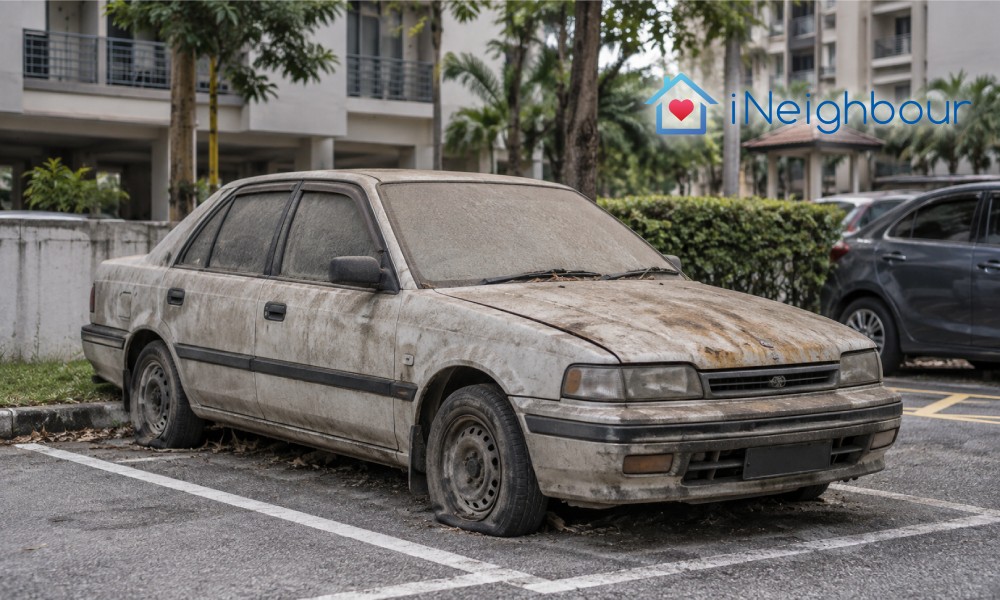
You have probably seen it before. A sun-bleached Proton Wira sitting in the same visitor bay for three years, tyres flat, bonnet lightly rusting, a layer of dust thick enough to write on. Neighbours complain at AGMs. The management committee sends notices that go unanswered. Someone calls DBKL. DBKL says it cannot help. Nothing moves, except the frustration.
So the committee asks the obvious question: can the JMB tow an abandoned car out of a visitor bay and be done with it? The answer is no — and the reason is not the one most committees assume. It is not that the law is silent. It is that nobody in the management office can prove who left it there.
Why the JMB cannot tow an abandoned car it did not register
Section 21 of the Strata Management Act 2013 places a duty on the JMB or MC to properly maintain and manage the common property. That is a duty to manage land. It is not a power to take possession of goods parked on it.
A vehicle stays the private property of its registered owner no matter how long it has been immobile, and a visitor bay changes nothing about that. Move it, store it, or scrap it without lawful authority and the management body — often the individual committee members who signed the instruction — carries the civil claim when the owner reappears. Disposing of a vehicle whose owner cannot be traced requires a court process. This is why the tow operator asks for an indemnity letter and the committee’s lawyer advises nobody to sign it.
The prescribed by-laws do give management bodies a clamping power and the right to charge for parking violations. Against abandonment, clamping is theatre. A clamp stops a car from being driven away. This one is not going anywhere.
A resident’s car is a records problem. A visitor’s car is a blank page.
When an abandoned car belongs to a unit, the committee has somewhere to start — an owner, a bay, an account to charge. A car in a visitor bay usually belongs to nobody the community has on file. It came through the gate mentioning a pick-up, and the only organisation that ever had the chance to record it was the guardhouse — which did not, because writing down a plate for a car leaving in five minutes holds up the line behind it.
That distinction decides everything that follows, because every authority the committee turns to asks the same opening question: who owns it, and how do you know?
The Strata Management Tribunal. Useful for disputes between the management body and a known party. It cannot make orders against an unknown owner, which is precisely the position a committee is in when the car arrived as an unrecorded visitor.


The local council. Parliament confirmed in February 2026 that councils have no direct enforcement authority over abandoned vehicles on strata-titled land. The Ministry is finalizing an amendment to the Road Transport Act 1987 to let PBTs tow abandoned vehicles in condominiums and flats without waiting for the management body, using Section 65 to shorten disposal. Others argue Section 72 of the Local Government Act 1976 already applies where the vehicle is a nuisance or a hazard — leaking fluids, blocking fire access. Either way, the council opens a file on the strength of the JMB’s documentation.
The Commissioner of Buildings. Will ask what the by-law says, what notices were issued, and what evidence supports the claim that the vehicle was abandoned rather than merely parked.

Three routes, one bottleneck. The committee is not blocked by a gap in the law. It is blocked by the absence of a record.
Abandonment is the end state of a check-out nobody verified
No car is abandoned on arrival. It is driven in, parked, and then simply never driven out. Somewhere in that sequence a visit should have closed and did not.
In most developments the gate captures a name on a logbook page and a plate written quickly by hand, or nothing at all when the barrier is lifted manually for a car that looked like it belonged. The pass is never returned, and nothing in the process treats an unreturned pass as an event. Guards rotate, the car becomes scenery, and by the time anyone raises it at an AGM, the only people who saw it arrive left the posting two years ago. We have written before about how the visitor check-out nobody verifies leaves a visit open-ended on paper while the vehicle is long gone — abandonment is the same failure running in the opposite direction, where the visit stays open because the vehicle never left.
What a defensible abandonment file contains
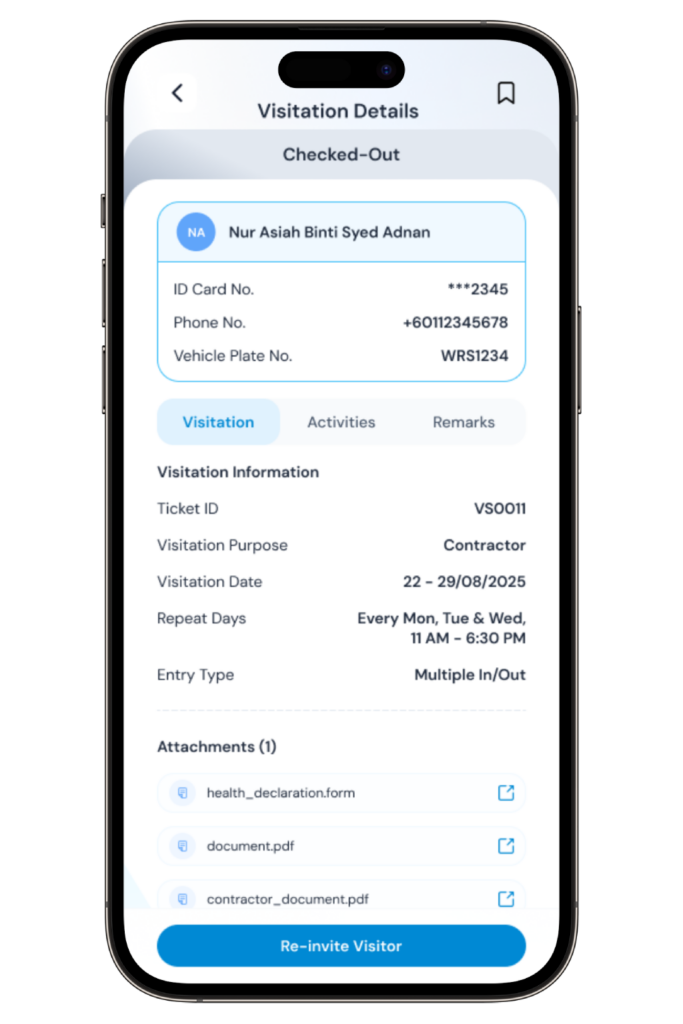
Every element an authority will ask for is a by-product of running visitor management properly, not a special investigation launched three years too late.
Entry is the first record that matters. Where LPR is in place, the plate is captured automatically at the barrier as part of check-in, so the arrival is a timestamped fact rather than a guard’s handwriting. In iNeighbour, that check-in belongs to a visit with a purpose and a host unit — which means the committee can later show who brought the vehicle in and on whose invitation.
Live Activity monitoring then flags what nobody watches for manually: a visitor checked in, with no matching check-out, past the permitted duration. An overstay alert on day two is a conversation with the host. On day sixty it is already an abandonment case, and the system has dated every day of it. The visitor profile accumulates the rest — plate, identification, visit history, and the flag that stops the same vehicle returning. When the committee finally writes to the council or the COB, it attaches an entry timestamp, a host unit, an unclosed visit, and a notice history with view and acknowledgement records, instead of a photograph and a collective memory.
Committees turn over every twelve to twenty-four months. The file does not, because it belongs to the site record rather than to whoever was secretary when the car arrived.