
The fixed-term contract is often used as a quiet insurance policy against dismissal claims. The logic is appealing: put an employee on a twelve-month term, and when it expires the employment simply ends. No termination, no notice argument, no case to answer at the Industrial Court, because nobody was dismissed. It is a tidy theory, and Malaysian courts have spent years taking it apart. The label on the contract does not decide whether an exit is clean. The substance of the relationship does.
The Label Does Not Decide It

The point was settled at the highest level in Ahmad Zahri Mirza Abdul Hamid v AIMS Cyberjaya Sdn Bhd. An employee had been engaged on a twelve-month fixed-term contract that was then renewed four times in succession, on the same terms, with no break between the terms. When the employer declined to renew again and treated the employment as ended by expiry, the Federal Court looked past the wording and found that what actually existed was permanent employment. The non-renewal was therefore a dismissal, and one without just cause and excuse.
That is the outcome employers who rely on fixed-term contracts least expect. The document said the term had simply run out. The court said a permanent employee had been dismissed. The gap between those two readings is the entire risk.
What Makes a Fixed Term Genuine
The court did not rule that fixed-term contracts are invalid. It ruled that their genuineness is a question of fact, and it set out what to examine. The first consideration is the intention of the parties, judged not by a clause but by what the arrangement was really for. The second is the employer’s conduct over the course of the employment, the pattern of how the relationship was actually run rather than how it was described. The third is the nature of the employer’s business and the nature of the work, in particular whether the role answers a genuinely temporary or project-bound need, or an ongoing one that the business will always have.
Read together, these ask a single question. Was this a real fixed-term need, or a permanent job placed on a series of expiring contracts to keep the exit door open? A genuine term survives that scrutiny. A disguised one does not.
Where Employers Build the Trap
The trap is almost always built the same way, and it is built by repetition. A role that the business needs permanently is filled on a fixed term, and because the person does the job well, the contract is renewed. Then renewed again. The renewals happen without the employee applying for them and without any break in service, and each one looks like a small administrative act. Cumulatively they are the evidence that the work was never temporary at all.
By the time the employer wants to end the arrangement, the contract history has quietly rewritten what kind of employment it is. Declining to renew a genuine one-year project role is an expiry. Declining to renew the fifth consecutive term of an obviously permanent job is a dismissal wearing the language of expiry, and it is treated as one.

The Record Is the Evidence
What makes this manageable is that the facts the court weighs are facts the employer already holds: when the person started, how many times the contract was renewed, whether the service was continuous, and how long the “temporary” role has actually existed. The problem is that these facts usually sit scattered across separate contract files, so the pattern only becomes visible once a lawyer assembles it.
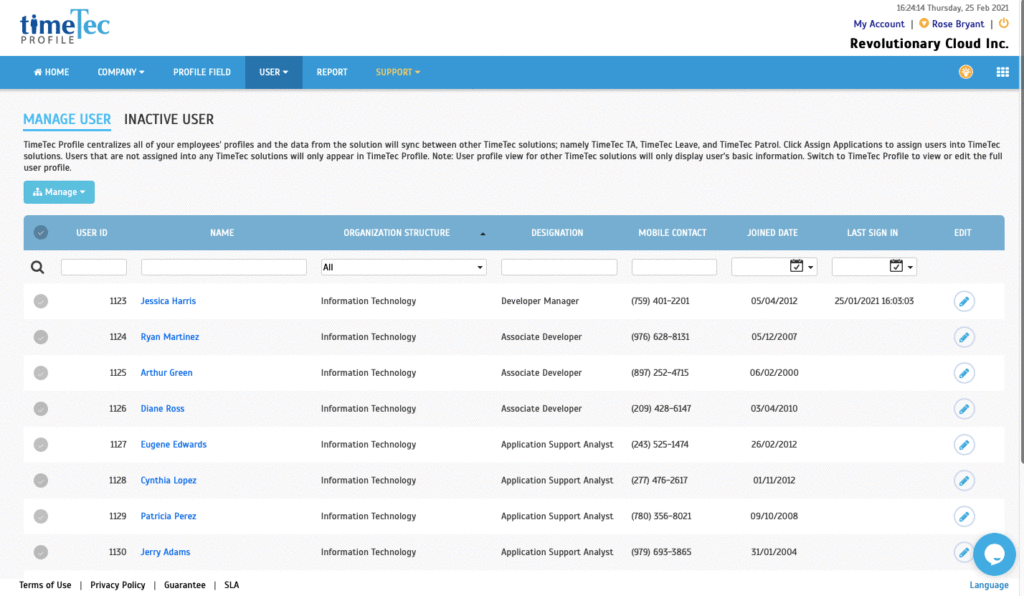
Holding the employment record in one place changes that. In a system like TimeTec HR, each employee’s contract type, renewal history and continuous service sit in a single profile, which means a role that has been renewed on fixed terms for years is visible as exactly that, long before it becomes a claim. Seeing the pattern is what lets an employer act on it deliberately, by confirming the person as permanent or genuinely restructuring the need, rather than discovering the truth of the relationship for the first time in a courtroom.
Substance Over Signature
A fixed-term contract is a legitimate tool for genuinely temporary work. It is not a way to convert permanent employment into a dismissal-proof arrangement, and treated as the latter it does the opposite of what it promises. The exit that was supposed to be automatic becomes the clearest evidence that a dismissal took place. The contract expires. The obligation does not.