
Walk any unit during the defect liability period and you will find the stickers on the floor. Someone marked each defect with a sticker at inspection — a dot on the cracked tile, a tab beside the chipped skirting. But construction surfaces are dusty, and a sticker on a dusty surface does not hold. By the time the contractor arrives to rectify, half the markers have peeled off and are lying on the floor, no longer attached to anything. The defect is still there. The one thing that told anyone where it was is gone.
This is the part of defect reporting nobody plans for: the location.
Floor Plan Defect Reporting Solves the Problem Descriptions Can’t
A defect report carries two pieces of information — what is wrong, and where it is. Teams put all their attention on the what. The where is treated as an afterthought: a sticker that falls off, or a line of text that means different things to different people. Yet the where is what decides whether the repair actually happens. This is the gap floor plan defect reporting closes, and it is worth being precise about why descriptions and photos alone cannot.
“Chipped tile in the living room” sounds specific until a contractor is standing in a living room with sixty identical tiles. He has a photo — but the photo is zoomed in on the chip, because that is the instinct when you take it. It shows the damage in perfect detail and tells him nothing about which tile, in which corner, near which wall. So he does the only thing he can: he gets down and checks tile after tile across the whole floor, looking for the one that matches the picture. The defect was reported clearly. The location was not.
And this is not only a paper problem. Plenty of digital defect systems have the same blind spot — they let the buyer type a description and upload an image, and stop there. Moving the report onto a screen does not help if the screen still cannot answer where. A context-less photo in an app is no more findable than a photo in an email.
Pinpoint the Coordinate, Not the Sentence
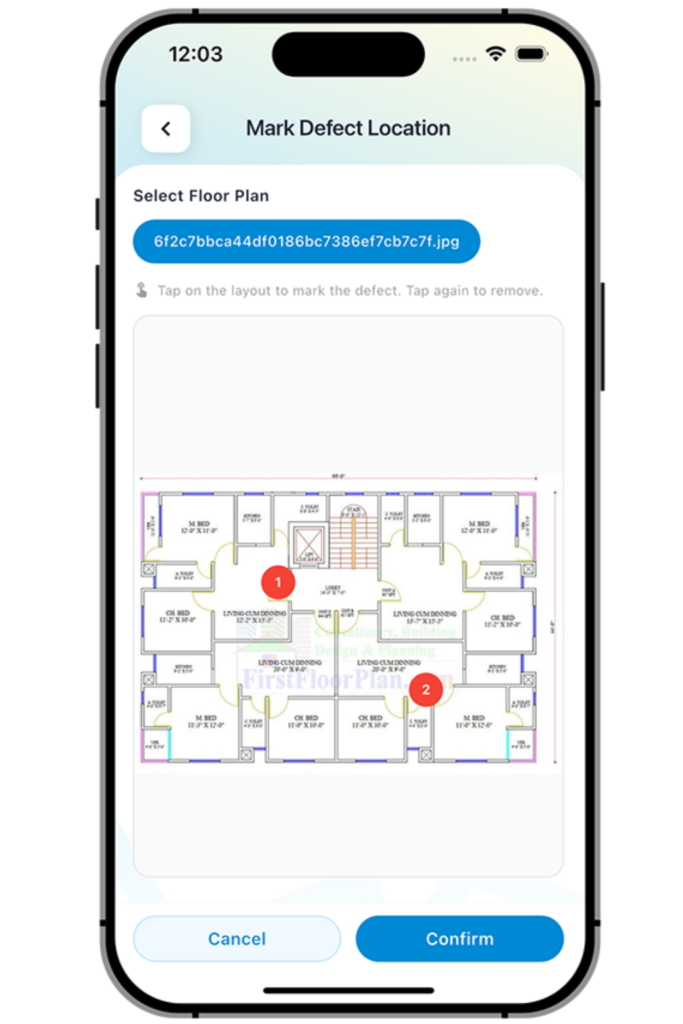
The fix is to stop describing location and start marking it. In iNeighbour, the buyer pinpoints each defect directly on the unit’s floor plan — placing it on the exact spot where the problem is — and attaches photos and videos for detail. The location is no longer a sticker that can fall off or a phrase open to interpretation. It is a point on the plan, and it is the same point for everyone who opens the ticket.
That precision holds because the report is made against the correct layout plan. On a project with several unit types, defects are pinpointed on the plan that actually matches the unit, so a mark in the “master bedroom” lands on the right room in the right layout rather than a generic outline. The buyer marks where they see it, and the contractor opens the same plan and sees exactly where to go.
The zoomed-in photo now works the way it should. It confirms what the defect looks like, while the pin on the plan answers where it is — the two pieces of information a report needs, finally travelling together instead of one arriving without the other.
What Changes When Location Is Certain
The gain shows up at the point where defect work usually leaks time and money: the site visit. A contractor who opens a ticket and sees the exact location on the plan arrives knowing where to go. There is no hunting across a floor of tiles, no call back to the office, no second trip because the marker was gone and the description was vague. On a single unit that is an inconvenience. Across hundreds of units in a live liability period, it is the difference between a repair schedule that moves and one that stalls on wasted visits.
Certain location also settles close-out. When a defect bounces back as “not fixed,” the argument is almost always really about location — did the contractor fix the right thing? When the ticket carries a pinpoint everyone agreed on, that ambiguity is gone. The defect that was marked is the defect that was repaired, and both sides are pointing at the same spot on the same plan.
A sticker tells a contractor where a defect was, until it falls off. A photo tells him what it looks like, but not where to stand. A pin on the floor plan tells him exactly where to go — and it is still there when he arrives.