
Start With the Money
A JMB or MC committee should talk about money. Every ringgit spent on the development belongs to the owners, and scrutinizing a system before approving it is the committee doing its job. The problem is that the conversation usually stops at the wrong number. When a property management system comes up, the question asked is “what does it cost.” The question that matters is “what is the cost of manual property management we are already paying.” That cost never appears on an invoice. It sits inside guard wages, admin salaries, overtime, and the weekends volunteer treasurers give up every month.
The Cost of Manual Property Management Is Real, Just Invisible
A subscription is a line item. You can see it, debate it, and put it to a vote. Manual labour behaves differently. It is spread across headcount and unpaid hours, so no single figure ever lands on the table for the committee to react to.
Each manual task looks manageable on its own. A guard writing a visitor into a logbook takes a minute. Matching one bank transfer takes a few minutes. Drafting one notice takes half an hour. None of it feels like a crisis. Stacked across a full month and a development that keeps growing, it becomes a permanent load that forces the same outcome every time: hire another admin, add another guard, or watch deadlines slip. The cost is real. It is just sitting where nobody thinks to look.
Four Places the Hours Disappear
Security at the Gate
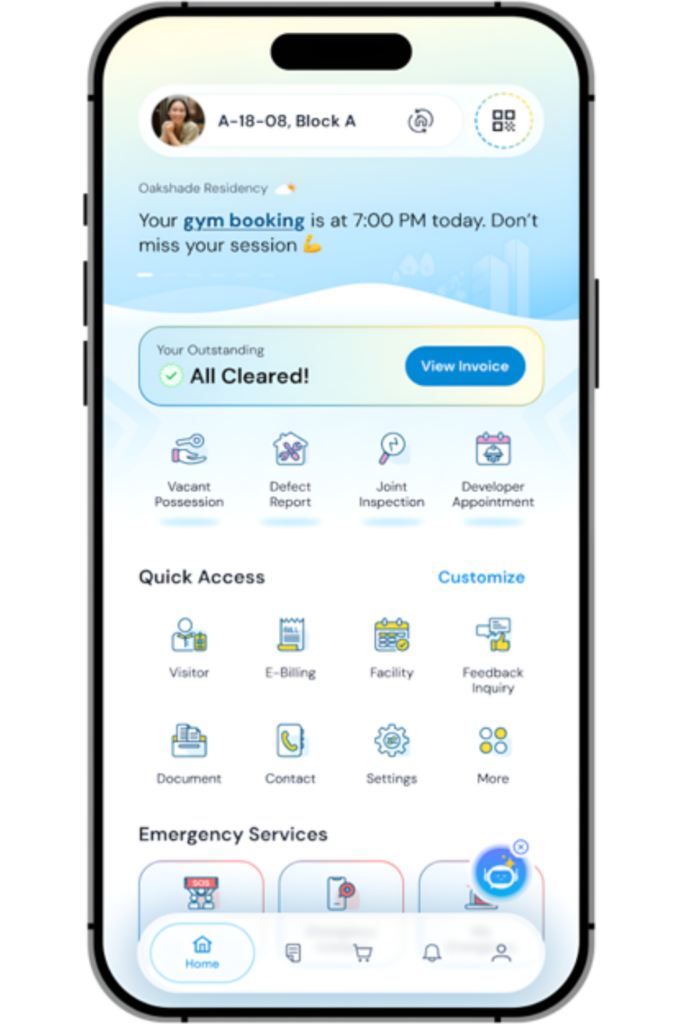
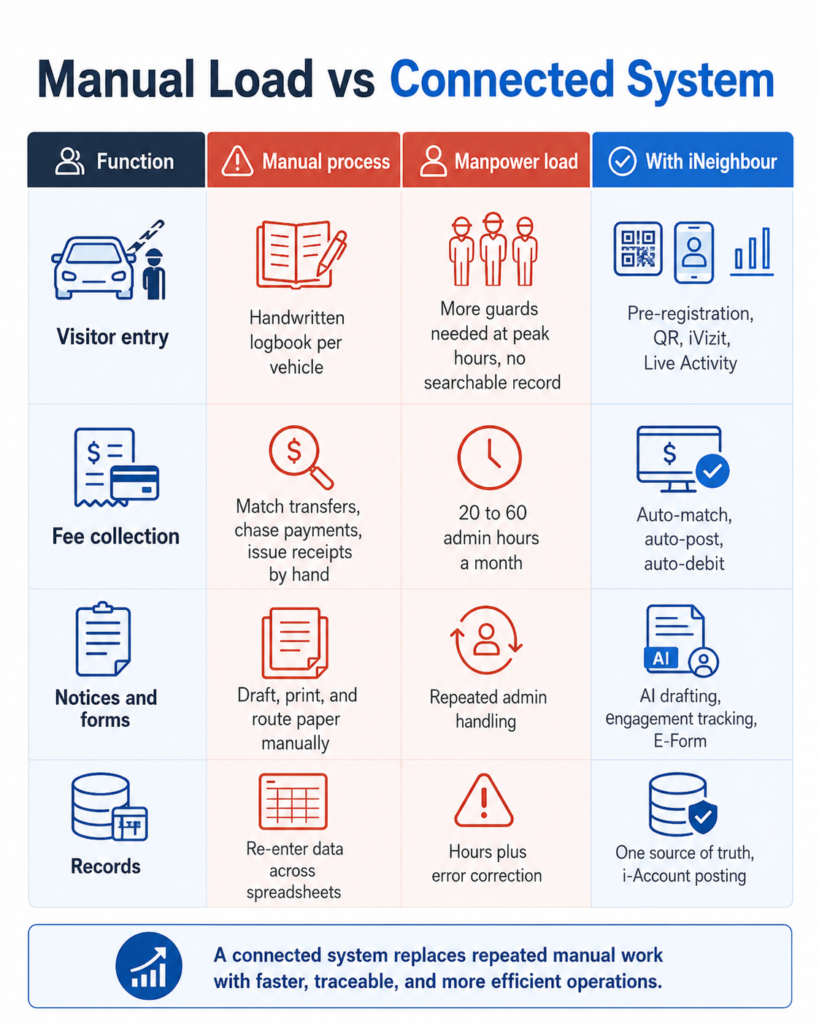
A physical logbook needs a guard to handwrite every visitor’s details, one vehicle at a time. During peak arrival hours this slows the gate, frustrates residents, and pushes management toward adding guards just to keep the queue moving. The record it produces also cannot be searched. After an incident, “who came in last Tuesday” means flipping through pages.
This is where the math changes. iNeighbour moves data entry off the gate. Residents pre-register guests in the app, visitors arrive with a QR code, and guards process arrivals through the iVizit guard app instead of a pen. Live Activity monitoring shows who is currently inside, who has overstayed, and who has left. A smaller team handles a higher volume of arrivals without losing traceability, because the system is doing the recording, not the guard.
Billing and Collection
This is the cost center most committees underestimate. Maintenance fees arrive as anonymous bank transfers with no reference, or a single transfer covering three months, or one family account paying for two units. Someone has to match each payment against the outstanding list, confirm it over WhatsApp, update the spreadsheet, and issue a receipt. Depending on the size of the building, that detective work runs 20 to 60 hours a month, spent entirely on figuring out who already paid.
E-Billing removes the work between the steps. Residents pay through their unit account, the payment auto-matches to the right invoice, posts straight into i-Account, and generates the receipt without anyone touching a spreadsheet. For residents who opt in, auto debit collects recurring fees on schedule, which is the single biggest lever on late payments. We covered this mechanism in detail in Auto Debit for Residential Maintenance Fees, and the labour saving is the same logic applied to every charge a building handles.
Admin and Communications
Notices get drafted, formatted, printed, and distributed with no proof anyone read them. Renovation and move-in forms move on paper, routed by hand from the guardhouse to the office to the committee. Each round trip is manpower. AI-assisted notice drafting produces a formatted notice in minutes, and engagement tracking shows view counts and acknowledgements, so the office stops re-sending and re-confirming. E-Form replaces the paper trail with multi-level digital approval that routes itself.
Records and Documents
Manual operations force the same data to be re-entered in several places: once in the resident list, again in the billing sheet, again in the accounting file. Every re-entry is an hour spent and an error waiting to surface. When records, billing, and accounting share one source of truth, the re-keying disappears, and so does the reconciliation work that follows every mismatch.
The Cost That Compounds
The reason manual operations feel survivable is that no single task is the problem. The problem is the sum. Every new block, every new resident, every new facility adds to a load that the same team cannot absorb forever, which is why manually run developments add headcount year after year just to hold the line. A connected system breaks that link. The same office handles a larger community because the work between steps is gone.