
The Leave Request That Disappeared
An employee submits a leave request on Monday. By Thursday, it is still pending. They check with their supervisor, who says they never received it. HR investigates and discovers the request was routed to the employee’s previous supervisor, who transferred to another department two months ago. The previous supervisor’s account still shows 14 pending approvals from three different employees, none of whom report to them anymore.
Nobody changed the approval chain when the transfer happened. Nobody knew they needed to. The system was doing exactly what it was configured to do. The configuration just no longer matched reality.
Why Approval Chains Break Silently
Approval chains do not fail loudly. They fail by doing nothing.

A leave request routed to the wrong approver does not bounce back with an error message. It sits in a queue that the wrong person never checks. A claim submitted for approval does not get rejected. It waits, indefinitely, in an inbox that belongs to someone who left the company. An overtime request does not expire. It stays pending until someone notices, usually the employee, usually after they have already worked the hours and expected the pay.
The silence is the problem. The system processes the routing exactly as configured, and the request enters a dead queue that nobody monitors. This happens across every module that has an approval flow. Leave. Claims. Overtime. Attendance edits. Each one breaks independently when the organization changes.
The Three Events That Break Everything
Approval chains do not break randomly. They break at predictable moments.
Promotions. An employee is promoted from executive to manager. Their reporting line changes. Their direct reports change. But if the leave approval flow was configured with a specific person as the approver, the system still routes the team’s leave requests to the old supervisor. The new manager has no visibility into their own team’s applications.
Department transfers. An employee moves from Sales to Operations. Their profile is updated. But the claim approval was assigned to a specific approver in Sales. The employee’s claims still route to the Sales department head, who approves expenses for an employee they no longer oversee, using a budget they no longer control.
Resignations. A supervisor resigns. Their direct reports are reassigned to a new manager. But the attendance module still routes overtime requests to the resigned supervisor’s account. The requests accumulate in an inactive inbox. The employees work the overtime, expect the pay, and discover at month-end that nothing was ever approved.
Each of these events is routine. Companies promote, transfer, and lose employees every month. The organizational chart updates. The HR announcement goes out. What does not happen is someone opening the approval configuration in every affected module and updating the routing to match.
The Configuration Choice That Causes the Problem
Most HR systems offer two ways to configure an approver.
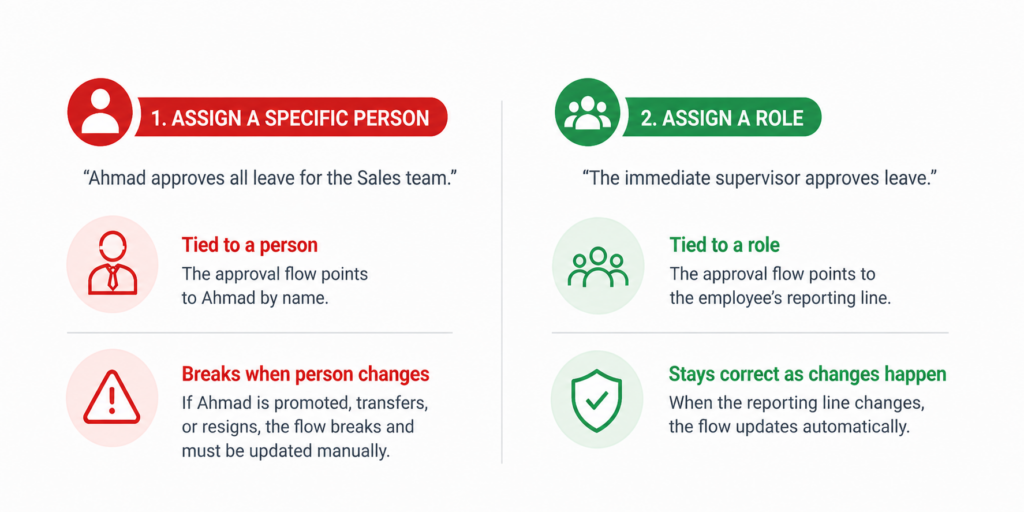
The first is to assign a specific person. “Ahmad approves all leave for the Sales team.” This is the most common approach because it is the most intuitive. HR picks a name, assigns them, and the flow works. Until Ahmad gets promoted, transfers, or resigns. Then every flow that points to Ahmad breaks, and someone has to find every instance of his name across every module and replace it.
The second is to assign a role. “The immediate supervisor approves leave.” This does not point to a person. It points to the reporting line defined in the employee’s profile. When the reporting line changes, the approval flow follows because it was never tied to a specific name.
The difference between these two approaches is the difference between an approval chain that breaks every time the organization moves and one that absorbs the change silently. Most companies use the first approach because nobody explained the consequence at the time of configuration.
The Fix That Was Always Available
The option to use Immediate Supervisor as the approver type exists in TimeTec HR across both Leave and Claim modules. When set to Immediate Supervisor, the system reads from the employee’s reporting line in Profile rather than from a hardcoded name.
The recommendation is straightforward. Use Immediate Supervisor as the default approver type wherever possible. Reserve specific-employee assignments for genuine exceptions: C-suite executives whose leave is approved by the CEO directly, or high-value claims that require finance director sign-off regardless of department.
When the approval flow is built around the reporting line, the three events that typically break everything are absorbed by the system. A promotion changes the reporting line in Profile. The leave approval follows. The claim approval follows. One update, and every downstream flow reflects the new reality. The one exception is requests that were already pending before the change. These remain routed to the former approver, so the employee would need to withdraw and resubmit for the new routing to apply. But every new request from that point forward goes to the right person automatically.
We wrote previously about how the shift calendar owns payroll logic so that payroll executes arithmetic instead of interpreting rules. The approval chain follows the same principle. The reporting line should own the routing logic, so that each module executes the sequence instead of maintaining its own list of who approves whom.
The fix was always available in the system. Most companies just never chose it because selecting a specific person felt more straightforward than selecting a role. That one configuration decision, made once during implementation and never revisited, is the reason the approval chain breaks every time the organization moves.
The Audit Question Nobody Wants to Answer
There is a compliance dimension that most companies do not think about until it matters.
When a leave approval is challenged, the question is not just “was it approved.” The question is “was it approved by someone with the authority to approve it.” If a leave request was approved by a supervisor who no longer managed the employee at the time of approval, the approval itself is questionable. The supervisor had no line authority. Their approval may not hold up in a dispute.

The same applies to claims. A claim approved by a department head from a different department is an approval made by someone with no budgetary oversight of the expense. If that claim is questioned in an audit, the company cannot demonstrate that the right person reviewed it.
These findings surface months or years after the approval was made, long after anyone remembers that the routing was wrong.
The Organizational Chart Moves. The Approval Chain Should Move With It.
Every company promotes employees. Every company transfers people between departments. Every company loses supervisors to resignation. These are the rhythm of any growing organization.
The approval chain is the one piece of HR configuration that is directly affected by every one of these events. And it is the one piece most companies never check until something goes wrong.
The fix is not checking more frequently. The fix is configuring the chain to follow the reporting line from the start, so that when the organization moves, the approvals move with it. The option has always been there. The question is whether anyone chose it.