
Owners often ask whether a condo parking bay belongs to them. Where the bay is registered as an accessory parcel to the unit, the owner has exclusive use of it — but exclusive use does not mean unrestricted use. The more useful question is what you can actually do with the bay, because condo parking bay rules in Malaysia regulate not just who may use a parking bay, but how the car park itself may be used.
Condo parking bay rules in Malaysia cover two different questions
The first is who may use the bay — whether an owner can let a tenant, a relative or an outsider park there. That turns on the bay’s status as an accessory parcel and on what the development’s by-laws permit. We covered it separately in Can a Unit Owner Rent Out a Parking Lot to Non-Residents Under Malaysia’s Strata Act?.
The second is what may occupy the bay — what an owner can park, store, build or install in it. This question has nothing to do with ownership. The prescribed by-laws in the Third Schedule to the Strata Management (Maintenance and Management) Regulations 2015 bind proprietors, tenants and occupiers throughout the development, and they apply to a parking bay whether it is common property or an accessory parcel attached to a unit. Owning the bay does not carve it out of the development’s rules.
So what is actually allowed?
| What the owner does | Position |
|---|---|
| Parks several motorcycles within one bay | Allowed, subject to obstruction and valid additional by-laws |
| Keeps a bicycle within the bay | Permitted within the bay; removable if it causes obstruction |
| Stores equipment, spare parts or discarded items | Prohibited |
| Builds a cage or enclosure | Requires prior written approval |
| Carries out major vehicle repairs | Prohibited |
| Stores petrol, gas or inflammable materials | Restricted |
| Installs an EV charger | Allowed subject to approval and safety requirements |
Several motorcycles in one bay — allowed
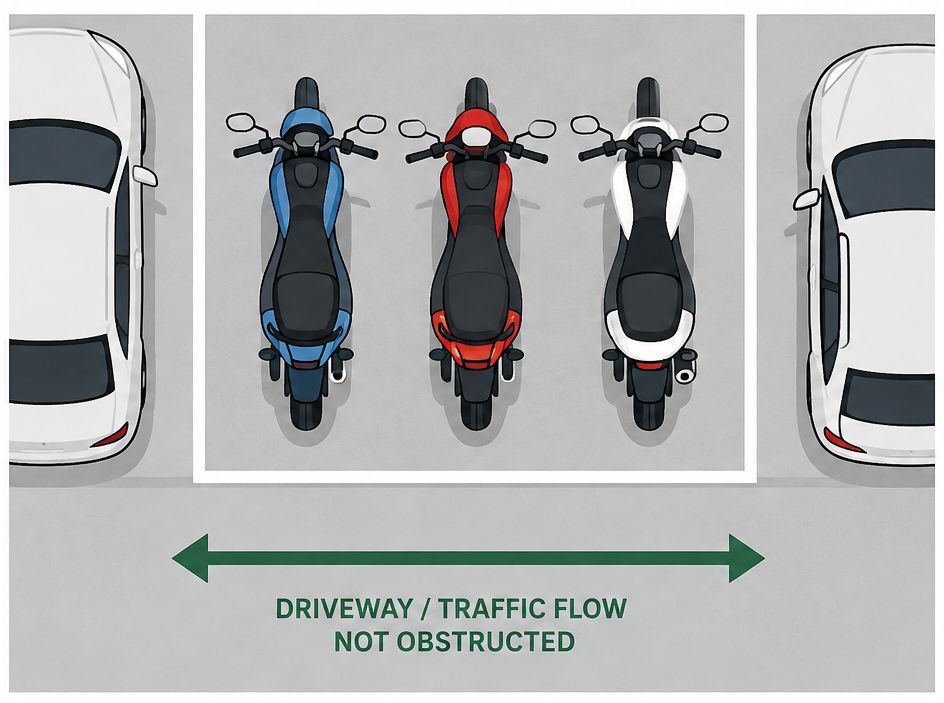
The Third Schedule imposes no one-vehicle-per-bay rule. By-law 25(1) requires a vehicle to be properly parked in the designated parking bay without obstructing an adjacent vehicle or the flow of traffic. Two or three motorcycles may therefore occupy the same bay as long as they remain within it and do not obstruct neighbouring vehicles or the driveway.
Management may still impose additional parking rules through valid additional by-laws. But without such a rule, the prescribed by-laws do not limit one parking bay to one motorcycle.
Bicycles — fine inside the bay, not in the way
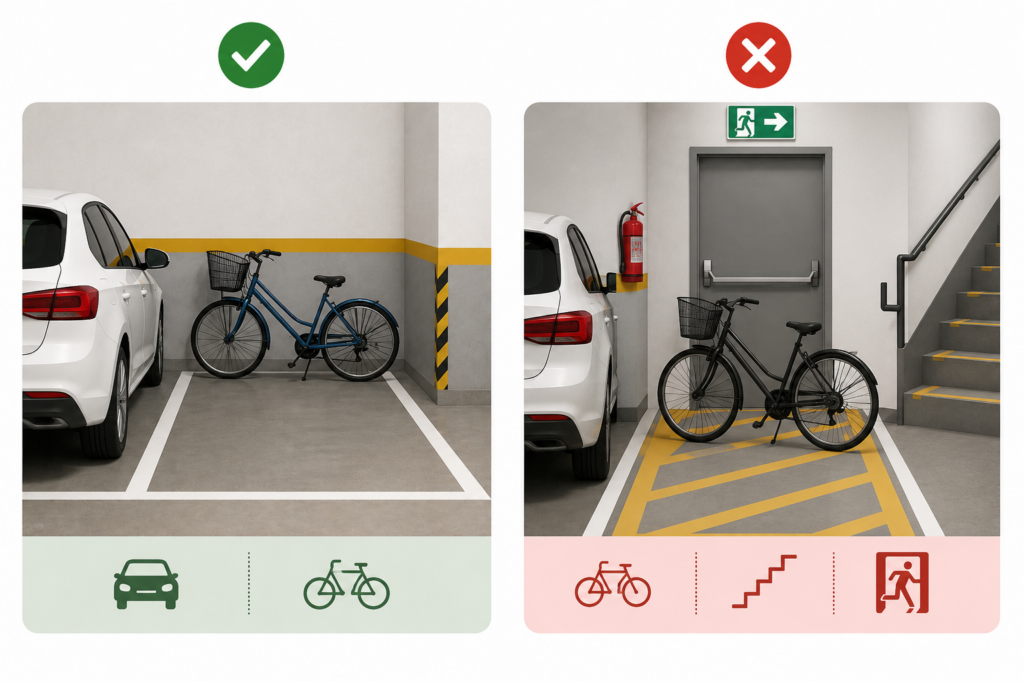
A bicycle kept neatly within the parking bay is different from one left in a corridor, stairway or escape route. By-law 20 requires fire escape routes, stairways, landings and passageways to remain unobstructed, and expressly allows management to remove or confiscate items including bicycles where they cause obstruction.
The practical answer is straightforward. A bicycle within the parking bay is fine. A bicycle obstructing common access or an escape route is not.
Boxes, spare parts and equipment — no
This is one of the clearest rules in the Third Schedule. By-law 25(5) states that a person using the car park must not leave equipment, spare parts, discarded material, rubbish or litter in the car park area. It also gives the management corporation power to remove and dispose of those items without prior notice and recover the cost from the person responsible.
A parking bay is for parking. It does not become an extra storeroom because it is attached to your unit.
A cage around the bay — only with approval
By-law 25(4) states that no additional construction or structure of any form may be erected on a parking bay without prior written approval from the management corporation. A cage, enclosure or gate is therefore not automatically unlawful — but the owner cannot simply install one. Approval comes first, and the proposed structure must also satisfy building and fire-safety requirements, particularly where it interferes with sprinklers, ventilation or access.
Major vehicle repairs — prohibited
By-law 25(3) prohibits major repairs involving excessive noise, fumes, oil spillage, chain blocks, or medium and heavy-duty lifting equipment. Changing a wiper blade is one thing. Turning the bay into a weekend workshop is another.
Petrol and gas cylinders — restricted
By-law 12 permits inflammable chemicals, liquids and gases for domestic purposes only, in quantities reasonably required for those purposes, and does not override other written laws regulating inflammable or explosive materials. An accessory parking bay is not a fuel or gas storage area, and fire-safety requirements apply regardless of whether the bay belongs to the unit.
EV charger — yes, but approval first
Installing a charger is not the same as building a storage cage, but both are alterations. In an existing strata development the owner should obtain JMB or MC approval, particularly where cabling, electrical risers, common property or the building’s electrical infrastructure are involved. Electrical works should be carried out by personnel or contractors registered under the requirements of the Energy Commission (Suruhanjaya Tenaga), and BOMBA fire-safety requirements may apply in basement parking areas.
So the answer is yes — but not as an unapproved DIY modification.
Who actually enforces parking rules
For an ordinary parking dispute, the JMB or MC is the first route. Management can enforce the prescribed by-laws and any valid additional by-laws adopted for the development.
Its authority is not the only one that matters. An unauthorised structure may involve the local authority. Unsafe electrical works may involve the electrical regulator. Fire-safety problems may engage BOMBA’s powers. Those authorities do not have to wait for a JMB dispute to run its course before their own statutory responsibilities become relevant.
The rule is only as good as the record
Enforcement should not begin with “we have always done it this way.” It should begin with a specific question: which by-law was breached?
Management should be able to produce the by-law relied on, the bay and unit involved, the vehicle, object or structure at issue, dated photographs or CCTV evidence, and the notices issued to the owner or occupier. Committee members change. Residents change. Verbal agreements disappear.
A by-law establishes the rule. A proper record proves the breach.