
Most JMBs handle tenancy management the way they handle everything else when there is no dedicated system for it: by improvising inside the tools they already have. Tenant details go into the resident listing. Key issuance gets noted on a physical form, if it gets noted at all. When tenancy details change, someone updates a spreadsheet — or they don’t.
This works until it doesn’t. In strata communities with regular tenant turnover, the gap between what is recorded and what is real tends to widen quietly — and nobody notices until the record needs to be accurate.
What Tenancy Management Actually Requires
A tenancy is not just a person in a unit. It is a defined relationship with a start date, an end date, physical items issued, and potentially multiple people involved under different arrangements. Managing it properly means holding all of that in one place — not scattering it across a resident list, a paper form, and a committee member’s memory.
The minimum a management office needs:
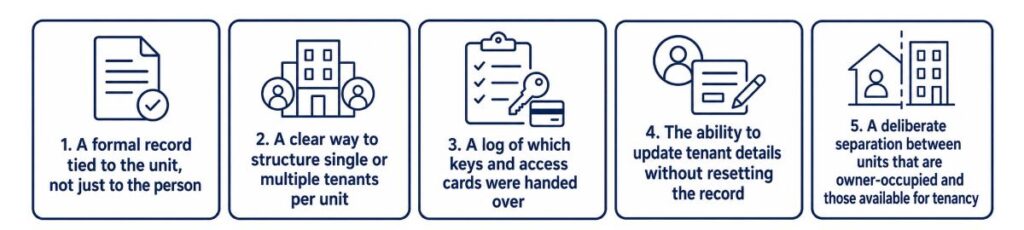
Most residential property management platforms were not built with this in mind. The result is that JMBs either manage tenancy entirely outside their property system, or they adapt a resident listing that was never designed for it.
How the Lease Module Changes the Structure
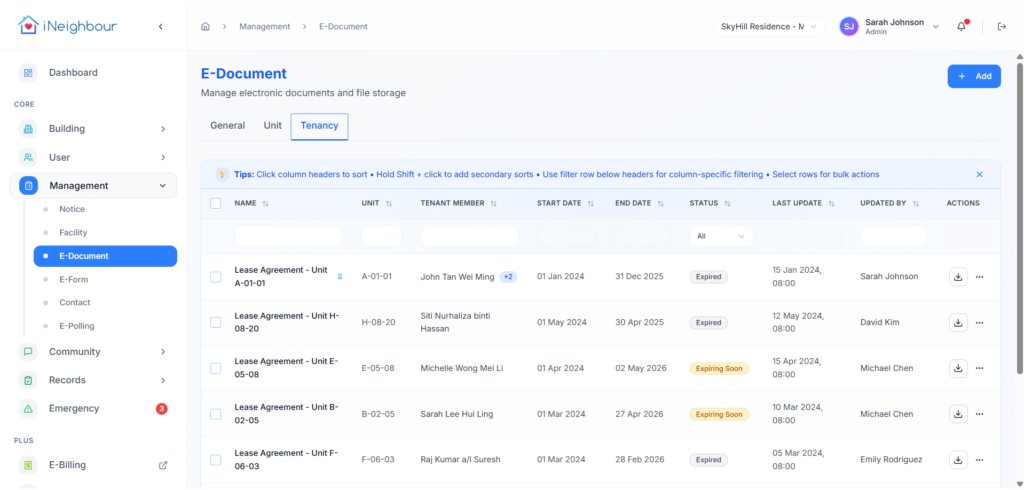
iNeighbour introduced a dedicated Lease module in V2 — the first version of the platform to treat tenancy as its own operational record rather than a workaround inside resident management.
The differences play out in practice.
One tenancy or individual tenancy — the JMB decides
The module supports two arrangements: a single tenancy record covering all tenants sharing the same unit, or separate tenancy records per individual tenant. A family renting as one household suits a shared record. Where tenants are unrelated individuals under separate arrangements, individual records keep things clean. The structure follows the actual living arrangement rather than forcing one format onto every situation.
Key and access card assignment tracking
When a tenancy is created, the physical items issued — unit keys, access cards, fobs — are logged within the tenancy record. At the end of the tenancy, the record shows exactly what was handed over and what needs to be returned. Most developments currently track this on paper or not at all. A logged record changes the handover from a conversation to a verified transaction.
Update without terminating
If a tenant’s contact details change, or one person in a shared arrangement moves out and is replaced, those changes can be made in place. V1 required removing the tenant entirely and re-adding them — which reset their record and created gaps in history. That constraint is gone in V2.
The leaseable designation
Before a unit appears in the Lease module, it must be marked as leaseable in the Building module. This is deliberate: ownership records and tenancy records stay structurally separate. An owner-occupied unit does not appear as a tenancy option. In larger developments with a mix of owner-occupied and rented units, this separation prevents the kind of confusion that produces unreliable records.
The Access Security Connection
We covered the risk of expired tenants retaining active credentials in Expired Tenants Still Have Access to Your Building — the pattern where former tenants remain in the system because nobody formally closed out their record. The Lease module addresses this by requiring a tenancy agreement with an expiry date before a tenant profile is created. When that date approaches, the system flags it for management to act on.
But the value of a proper lease record goes further than access control. A JMB with accurate tenancy records knows, at any point, who holds a current documented right to occupy each unit, what physical assets are outstanding, and which tenancies are active versus lapsed. That is not just a security function. It is the operational foundation for managing a rented community responsibly.
A Record That Reflects Reality
The resident list tells you who registered. The Lease module tells you who has a current, documented right to be there — and what the management office issued them when they moved in.
For developments where a significant portion of units are tenanted, the gap between those two things is not cosmetic. A list assumes. A record confirms.