
The JMB Committee Handover Problem
Every AGM season tells the same story. A new committee is elected. The outgoing chair hands over a folder of printed minutes, a few WhatsApp screenshots, an Excel sheet named differently from last year’s version, and a treasurer Gmail account that nobody can log into because the password lived in one person’s head. Three weeks later, the new committee is still asking the previous treasurer questions that should have been answered by the records themselves.
This is the JMB committee handover system most strata developments operate without realizing it. Committees change every twelve to twenty-four months. The community itself does not. Yet the records that govern that community are routinely tied to the people who happen to be holding office at the time, which means every election quietly resets the institutional memory of the development.
The question is not whether your committee will change. It is whether your records will survive when it does.
Where the Records Actually Live
Walk through how a typical strata community stores its operational data and the picture looks consistent across developments of every size.
Financial records sit in the treasurer’s personal laptop, in spreadsheets built around that treasurer’s own preferences. Defaulter histories live in screenshots inside a chat group. AGM minutes are stored on the secretary’s personal Google Drive. Vehicle blacklists are taped to the guardhouse wall. Notices to residents are sent from a personal phone, with no record of who actually received them.
When a committee changes, all of this transfers as a goodwill exercise rather than a system handover. What gets passed across is whatever the outgoing officer remembers to mention. What gets lost is everything else.
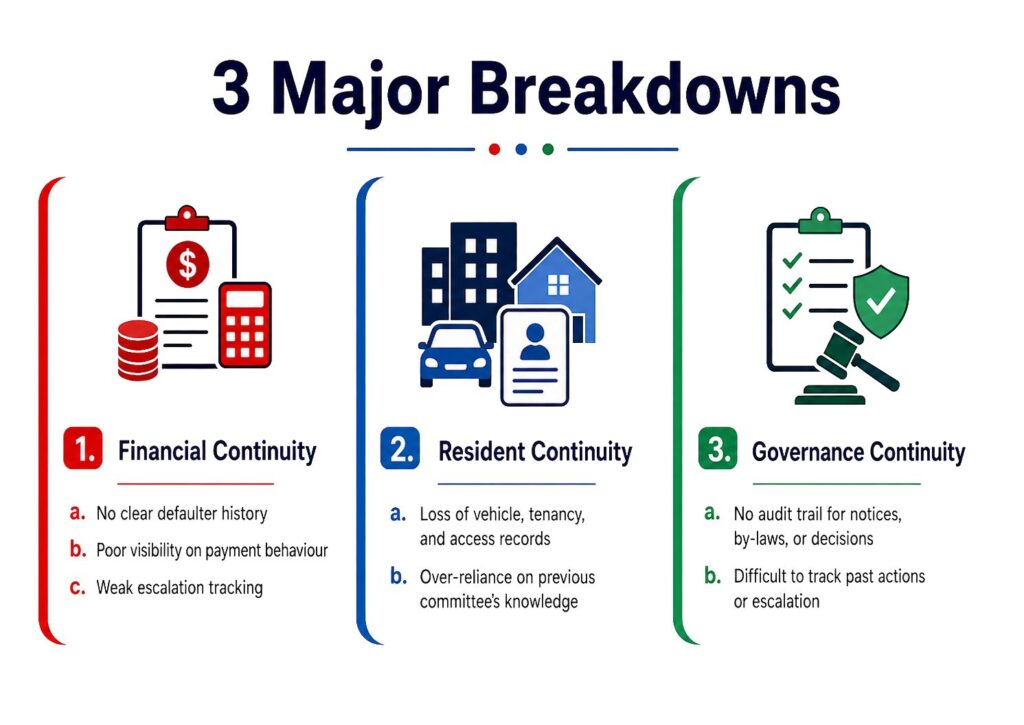
Three categories of loss show up consistently. Financial continuity breaks because escalation history was never documented, so the new treasurer cannot tell whether a unit is a chronic defaulter or a one-time late payer. Resident continuity breaks because vehicle approvals, tenancy records, and access credentials lived in the head of the previous chairman. Governance continuity breaks because there is no auditable trail of which notices were issued, which by-laws were passed, and which decisions were already escalated to the next stage.
What a Real Handover Should Transfer
The standard for a strata handover should not be “whatever the outgoing committee remembers to share.” It should be the operational state of the community as a verifiable record.
Day one of the new committee should look like this. Admin permissions transfer without anyone handing over personal passwords. Every approval, every notice issued, every defaulter escalation, and every vehicle blocked carries a timestamp and an acting officer attached to it. Notice records show not just what was sent but who received and acknowledged each one. Vehicle and visitor blacklists carry across without rebuilding. The defaulter list shows the full escalation timeline for each unit, not just the current outstanding amount.
That is what continuity actually means. Not goodwill. Not handover meetings. A system that holds the community’s records independently of who is currently sitting on the committee.
The Platform as Institutional Memory
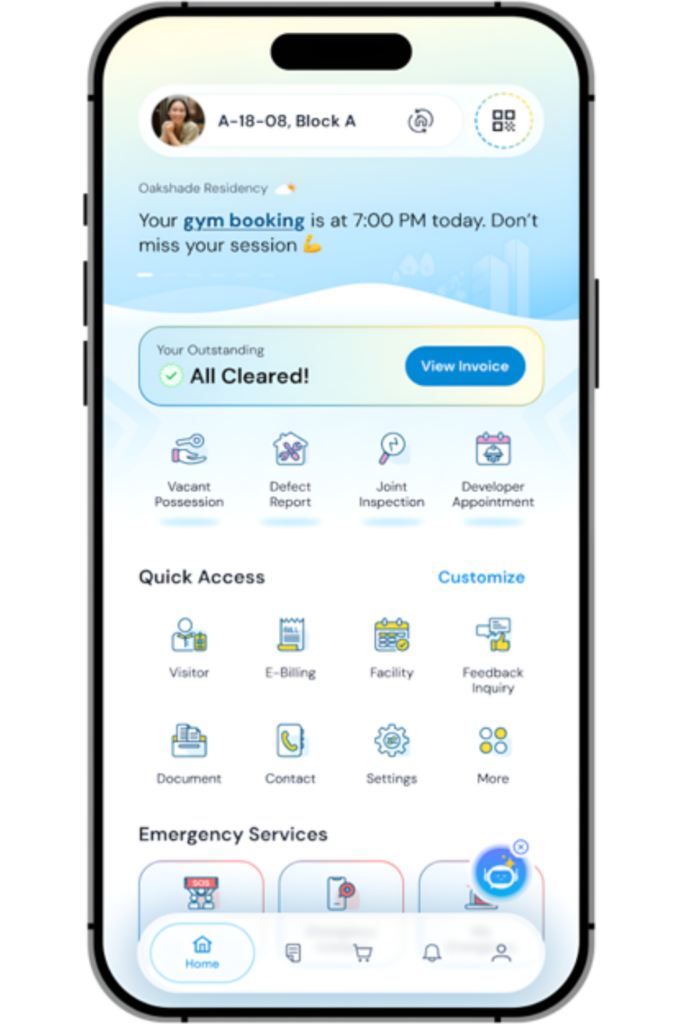
A property management platform earns its place in a strata community when it stops being a software tool and starts being the institutional memory layer. iNeighbour is built around this principle.
Admin roles are managed centrally, with View, Edit, Add, Delete, Export, and Approver permissions configurable per role. When a treasurer steps down, the role is reassigned to the incoming treasurer. No credential sharing, no passwords passed around in a chat group. Every action across every module carries an activity log, so the next committee can reconstruct exactly what was done, when, and by whom.
E-Billing posts directly to i-Account, which means financial history becomes platform-owned rather than laptop-owned. Defaulter records, collection escalation steps, payment history, and outstanding balances stay visible to whoever holds the treasurer role at any moment. Notice records track view counts, first-view timestamps, last-view timestamps, and acknowledgment status, turning community communications into governance evidence rather than message broadcasts. E-Forms in progress, pending approvals, active visitor flows, and tenancy records all persist through a role change because they were never tied to a person in the first place.
The Handover Checklist Worth Running
For committees preparing for an AGM, five operational transfers matter more than the formal documents:
- Admin role reassignment, not credential transfer. New officers receive their own login with role-based permissions. Departing officers are deactivated with their action history preserved.
- Pending E-Forms and active workflows. Move-in requests, renovation applications, and maintenance reports already in progress carry across with full status visibility.
- Defaulter records with full escalation history. The incoming treasurer sees the complete payment timeline, not just the current outstanding figure.
- Vehicle, visitor, and tenancy whitelists. Approved residents, registered vehicles, recurring contractors, and active tenancies remain in place without manual rebuilding.
- Notice and acknowledgment archive. Every issued notice, with its delivery and acknowledgment record, becomes available to the new committee as audit-grade governance evidence.
A committee that runs this checklist hands over a community in working order. A committee that does not hands over a relationship management exercise.
A Community Older Than Its Committee
Every strata development outlives the people who manage it at any given moment. The records that govern that development should outlive them too.
A committee changes every two years. A community’s records should not.
If your development is heading into an AGM with no system holding its institutional memory, request a demo of iNeighbour to see how committee transitions become administrative events instead of operational reset moments.