A Database That No One Updates
Every strata development has a vehicle database. Most of them are wrong.
Not because anyone made a deliberate mistake, but because the process that feeds them is broken. A tenant moves out. The owner finds a new tenant. The access card, a physical object with no link to any identity, gets passed along. The new tenant taps in and out every day with a card registered to someone who left six months ago. The management office never receives a new vehicle registration because nothing in the process requires one.
Multiply this across dozens of units over a few years and the result is predictable: a vehicle database full of plates that no longer match the cars actually parked in the building. Management cannot enforce bay limits because they do not know whose car is where. They cannot act on a defaulter’s vehicle because the plate on file belongs to a former tenant. And when an incident occurs, whether an accident, a break-in, or a dispute over an occupied bay, the records point to someone who no longer lives there.
The decay is silent. No one notices until something goes wrong.
The Card Problem Is a Design Problem
The root cause is not negligence. It is the access model itself.
A card-based parking system separates the credential from the identity. The card opens the barrier. It does not verify who is behind the wheel. It does not confirm that the vehicle entering bay 7A is the same vehicle registered to unit 7A. It does not flag that the tenant linked to that card moved out three months ago.
Because the card works regardless of who holds it, there is no forcing function to update records. The new tenant has access from day one without registering anything. The management office has no trigger, no prompt, and no reason to suspect the database is drifting further from reality with every quiet tenant changeover.
This is not a discipline problem. It is a structural one. And the structural fix is to make the vehicle itself the credential.
LPR Turns the Plate Into the Access Credential
License Plate Recognition changes the equation at the most fundamental level: the registered plate is the access credential. If your plate is not in the system, the barrier does not open. No card to hand over. No workaround. No silent decay.
This single shift changes behavior across the entire community. A new tenant cannot drive into the basement on day one using a passed-down card. They must register their vehicle, including plate number, photos, and unit assignment, before the system grants access. The management office reviews and approves the registration before it goes live. And because each plate is tied to a unit and its tenancy record, when a tenancy ends, those plates are flagged for review rather than quietly carried over to the next occupant.
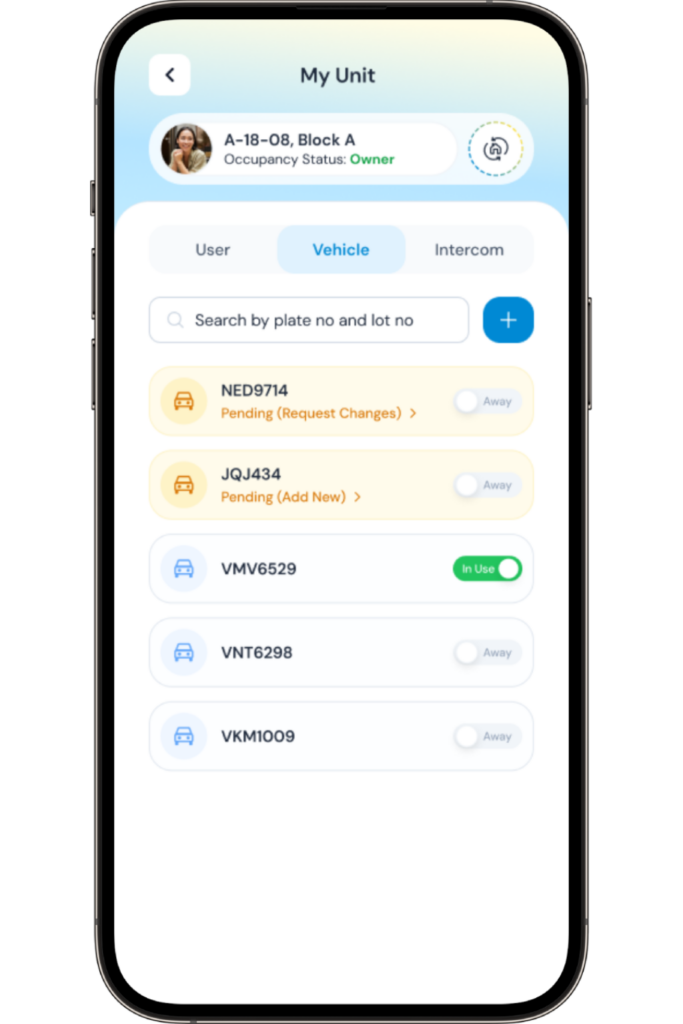
With iNeighbour, vehicle registration is built into the unit record itself. Each vehicle profile supports up to four photos (plate, front, side, and back) along with file attachments and an approval workflow. Management can configure a maximum number of vehicles per unit, and every new registration requires admin approval before the plate is activated for barrier access. Residents can register their plates directly from the iNeighbour app, but the management office holds the approval gate.
The result is a vehicle database that stays current not because someone remembered to update a spreadsheet, but because the system will not work unless records are accurate.
Tie It to the Tenancy Record
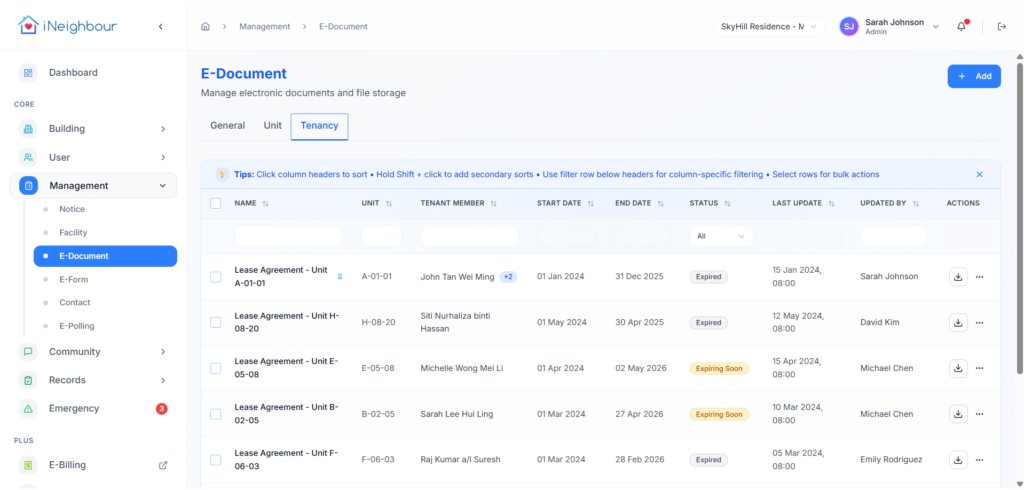
The vehicle registration gains another layer of integrity when it connects to the lease record. When a tenancy agreement is tracked in the system, management receives a prompt when that agreement expires, a direct flag that the plates linked to that tenancy need to be reviewed and deactivated if the tenant has moved on.
This is not a set-and-forget automation. It is a prompted response that puts the decision in management’s hands at the right moment, rather than hoping someone notices months later. The new tenant then goes through a fresh registration: new plates, new photos, new approval. No inherited records. No ghost data.
We explored the broader problem of expired tenants retaining access credentials in a previous post, Expired Tenants Still Have Access to Your Building. The vehicle registration problem is the parking-side extension of the same issue, and LPR is what closes the loop.
Defaulter Enforcement Without Confrontation
When vehicle records are accurate and linked to the property accounting system, defaulter management becomes a system function rather than a human confrontation. iNeighbour’s integration with i-Account allows management to auto-disable a defaulter’s registered plates. The barrier simply does not open. No phone call, no awkward lobby conversation, no letter that gets ignored.
This only works when the plate on file actually belongs to the person who owes the money, which circles back to why accurate, lease-linked vehicle records matter. Defaulter blocking on top of a decayed database punishes the wrong people.
Residents Get Control Too
LPR-based vehicle management is not only a management tool. Residents benefit directly:
- Self-registration from the app. Residents add or update their plate numbers from their phone, subject to management approval, without visiting the management office.
- Vacation plate disabling. Residents traveling can disable their plate temporarily to prevent unauthorized use of their parking bay while they are away.
- Visitor pre-registration. Residents can pre-register a visitor’s plate for automatic barrier entry, eliminating the guardhouse queue. Walk-in visitors registered at the guardhouse get LPR-verified exit, and every entry and exit triggers an alert notification to the resident’s app.
These are not convenience features layered on top. They are operational outcomes of a system where the plate database is accurate and connected.
The Access Card Era Is Ending
A card-based system was adequate when the only requirement was opening a barrier. It is not adequate when the requirement is knowing who is parked in your building, enforcing payment obligations, managing tenant turnover, and giving residents real-time visibility over who is entering their community.
LPR does not just add a feature. It restructures the relationship between vehicle access and vehicle identity, and forces the records to stay honest.