
The Governance Gap No One Audits
Every JMB and MC in Malaysia has the same obligation under the Strata Management Act 2013: communicate with residents. AGM notices, by-law amendments, levy adjustments, maintenance schedules, special resolutions. These are not optional updates. They are governance acts that require delivery, and in many cases, proof of delivery.
Yet most management offices have no idea whether residents actually receive what they send.
A physical notice board in the lobby serves whoever walks past it. A WhatsApp blast reaches whoever has not muted the group. A printed letter in the mailbox reaches whoever checks their mail that week. None of these methods tell you who read it, when they read it, or whether they understood what was required of them.
This is not a technology complaint. It is a governance failure. When a resident stands up at an AGM and says “I was never informed,” the committee has no evidence to the contrary. The notice was sent. Whether it was received is anyone’s guess.
The Three Reasons Community Communications Fail
The problem is not that management offices do not try. Most try hard. The problem is structural, and it breaks down in three specific places.

Targeting
Most community notices go to everyone. A water tank cleaning schedule for Block A reaches all 500 units across four blocks. A reminder about renovation deposit refunds goes to owners and tenants alike, even though only owners are eligible. A special levy notice goes to the entire development when only a subset of units are affected.
When residents receive notices that are irrelevant to them repeatedly, they learn to ignore everything. The signal-to-noise ratio collapses. By the time a genuinely important communication arrives, the audience has already tuned out.
The fix is not better writing. It is better targeting. Notices must reach the right group, at the right time, with content that is relevant to their specific situation. Role-based delivery, where a notice can be directed to owners only, tenants only, a specific block, or a specific floor, is the structural answer to an attention problem that no amount of bold text and red fonts will solve.

Quality
Management offices are typically staffed by two to three people handling everything from security coordination to billing to vendor management. Writing a professional formal notice about a by-law amendment or a sinking fund adjustment is not a core competency. It takes hours to draft, the language is often unclear, and the result rarely looks like an official governance document.
This matters more than most committees realize. A poorly written notice undermines the authority of the communication itself. Residents question whether the committee is competent. Disputes arise not because the decision was wrong, but because the notice explaining it was ambiguous.
The resource constraint is real and it is not going away. Management offices will never have a dedicated communications team. What they need is a way to produce clear, professional notices without the overhead of drafting from scratch every time.
Accountability
This is where most systems fail completely. A notice is posted. A message is sent. But there is no record of who viewed it, when they viewed it, or whether they acknowledged receipt.
Without that record, every communication exists in a gray area. The committee believes it informed residents. Residents claim they were never told. Neither side can prove their position. This ambiguity fuels disputes at general meetings, delays enforcement on arrears, and weakens the committee’s ability to govern.
If the communication layer cannot prove delivery, the enforcement layer has no foundation.
What Changes When the System Closes the Loop
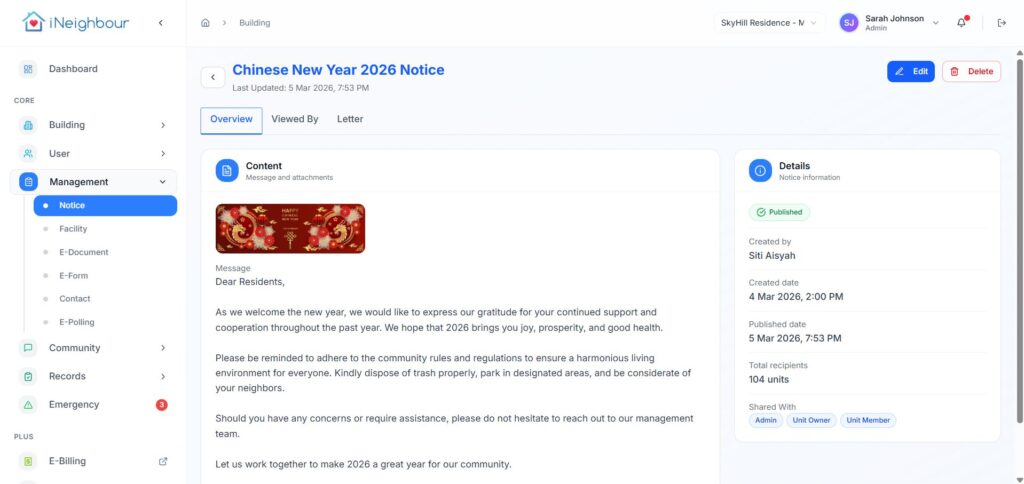
iNeighbour V2 rebuilds the notice module around these three failures.
Targeting is handled through role-based delivery. A notice can be directed to specific user roles, specific blocks, or specific units. The committee decides who needs to see it, and only those residents receive it. This is not a filter applied after the fact. It is configured at the point of creation, so the notice never reaches anyone it was not intended for.
Quality is addressed through AI-assisted drafting. An administrator enters the intent of the notice, a prompt describing what needs to be communicated, and the system generates a drafted notice with professional language and structure. It also produces a formatted letter automatically saved as an attachment. The management office reviews, adjusts if needed, and publishes. What previously took hours now takes minutes, and the output carries the professionalism that governance communications require.
Accountability is where the real shift happens. Every notice published through the system tracks view counts, first view timestamps, last view timestamps, and acknowledgement status per recipient. When a committee needs to demonstrate that a special resolution notice was delivered ahead of an EGM, the data exists. When a resident claims they were never informed about a levy increase, the record shows the exact date and time they opened the notice.
Scheduling and pinning round out the system. Notices can be prepared during office hours and published at the time residents are most likely to engage, typically evenings or weekends. Critical notices can be pinned to remain visible at the top of the listing, ensuring they are not buried by routine updates.
Communication Is Not Administration. Communication Is Governance.
The difference between a well-run strata community and a dysfunctional one is rarely about the rules. Most by-laws are reasonable. Most committees act in good faith. The breakdown happens in the space between a decision being made and a resident being informed.
Close that space, and disputes drop. Close that space with proof, and governance becomes enforceable.
A notice that no one reads is not a notice. It is a liability.