
Why Residential Maintenance Fee Collection Still Runs on Manual Effort
Every JMB, MC, and resident association committee knows the pattern. Invoices go out at the start of the month. By the fifteenth, half the development has paid. By the thirtieth, the management office is printing reminder letters, calling unit owners, and updating spreadsheets line by line. The residents who owe money are not always unwilling. Many simply did not get around to it because paying required effort they were not prepared to make at that moment.
This is where residential maintenance fee collection breaks down. The problem is rarely that residents refuse to pay. The problem is that the payment process itself creates friction. Limited payment windows, inconvenient methods, and no way to automate a recurring obligation that is the same amount every single month. The management office absorbs all of that friction as administrative labour.
What Manual Collection Actually Costs
The direct cost is obvious: staff hours spent issuing reminders, reconciling bank transfers, and following up individually with each outstanding unit. But the indirect cost is larger. Committee members spend meeting time discussing defaulters instead of development improvements. Relationships between neighbours deteriorate when enforcement becomes personal. And the longer an outstanding balance sits unresolved, the harder it becomes to collect. A three-month default is a conversation. A twelve-month default is a legal matter.
Most management offices have tried partial solutions. Bank transfers matched manually against unit numbers. Payment counters during office hours. A single online payment channel. Each reduces friction in one direction while leaving others untouched. The gap is not a missing payment channel. The gap is a missing collection system. One that automates recurring charges for willing residents and offers alternative methods for the rest.
Auto Debit: The Resident Pays Once, the System Collects Every Month
The single most effective change a residential development can make to its collection model is introducing auto debit. A resident authorizes a recurring charge and the system collects the maintenance fee automatically on each billing cycle. No reminder needed. No login required. No manual bank transfer to forget about.
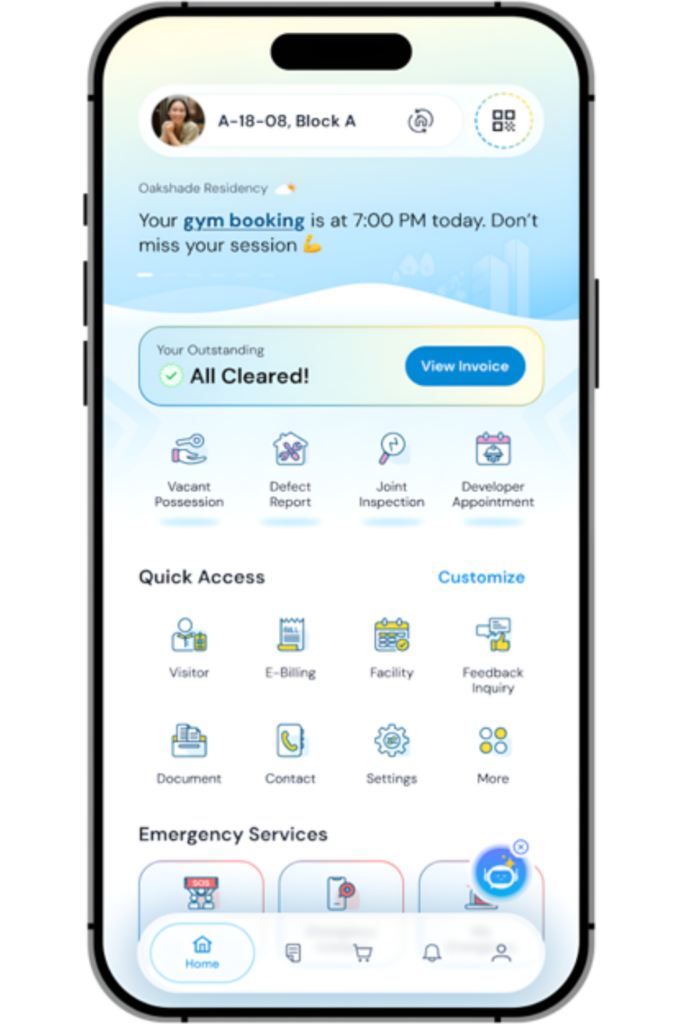
This is what iNeighbour delivers through its E-Billing module. Residents who opt into auto debit set up the authorization once, and the platform handles collection every month without further action from either side. The maintenance fee becomes no different from a phone bill or streaming subscription. It simply gets paid.
The impact is structural. When even thirty to forty percent of a development’s units are on auto debit, the management office’s monthly workload drops by the same proportion. The remaining effort focuses entirely on the units that need attention, not spread across the entire development.
Other Payment Options for Residents Who Prefer Control
Not every resident will opt into auto debit. Some prefer to review each charge before paying. Others use specific banking channels out of habit. A collection system that depends entirely on auto debit will still leave gaps.
Beyond auto debit, iNeighbour’s E-Billing also supports one-time payments through credit card, debit card, FPX online banking, and eWallet. Residents who want to pay manually each month can do so through whichever channel they already use. Every transaction, whether auto-debited or manually paid, lands in the same billing system with the same tracking and the same reconciliation path. The management office does not need to know which channel a resident used. It only needs to see whether the invoice has been settled.
From Collection to Enforcement: Handling the Remaining Defaulters
No payment system eliminates defaulters entirely. Some residents face genuine financial difficulty. Others deprioritize maintenance fees regardless of convenience. The difference a proper billing system makes is clarity. The management office knows exactly who has paid, who has not, and how long each balance has been outstanding.
iNeighbour’s E-Billing integrates directly with i-Account for property management accounting, auto-posting every transaction so financial records stay current without manual re-entry. Outstanding balances surface at the dashboard level, giving committees the data to act proportionally. A first reminder at thirty days. A formal notice at sixty. Escalation only when justified.
We previously explored this graduated approach in How JMBs and MCs Can Use iNeighbour to Handle Defaulters Effectively Without Overdoing It. When auto debit and accessible payment channels have already removed the friction excuse, the residents who remain outstanding are a smaller, clearer group. Enforcement becomes targeted rather than blanket.
The Real Question for Committees Evaluating a System
The question is not whether your development needs an online payment option. Most committees already know they do. The question is whether your current process allows a resident to authorize one payment and never think about maintenance fees again. If it does not, the management office is doing work every month that a system should be doing for it.