
Every guardhouse has the same quiet ritual at shift change. The outgoing guard tallies the visitor passes still unaccounted for, then works backwards — which pass number went to which car, which unit, how long ago. It is the only way a manual system can answer a simple question: who is still inside who should have left? A visitor overstay alert removes that ritual entirely. Instead of reconstructing an overstay after the fact, the system surfaces it the moment the visit window lapses — and names the visitor.
That gap between checking and being told is the whole point.
Finding a Visitor Overstay Shouldn’t Require Counting Passes
In a manual setup, an overstay is invisible until someone goes looking — and the person who would go looking is already busy. During peak hours the guard is registering walk-ins, verifying identities, issuing passes, taking calls from residents, and directing traffic at the barrier. Reconciling who has overstayed is the one task that always loses. There is no spare moment to walk down a stack of active passes and check them one by one, so nobody does.
The passes themselves make it worse. A visitor picks up a pass for what looks like a quick drop-off or pick-up, then stays inside for hours. On paper it is one more pass in the pile, indistinguishable from a legitimate short visit. To catch it, a guard would have to match every issued pass against a time expectation manually — pass #47 to a name, a unit, a time in — precisely the reconciliation there is never time for. So the visit that mattered sits buried, and the overstay is noticed at the next handover, if at all.
From a Round of Checking to a Real-Time Signal
The manual model depends on someone performing a round of checking. Every overstay you catch is a function of how often, and how carefully, a guard reconciles passes against the log. When the guard is occupied — which is most of the time — that round doesn’t happen, and the overstay goes unseen.
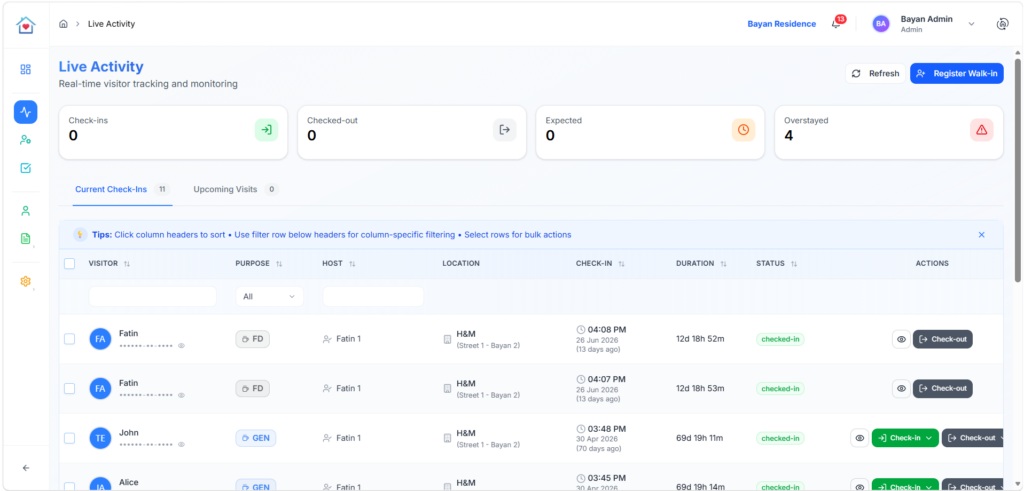
This is where iNeighbour changes the operating model. Its Live Activity Monitoring page holds every current visit in one view, with summary cards for checked-in, checked-out, expected, and overstayed visitors. When a visit passes its expected duration, it moves into the overstayed count automatically, with a visual indicator — no reconciliation, no counting. The guard doesn’t go looking for the overstay. The overstay announces itself, tied to the visitor’s name, host unit, car plate number, and time in.
That matters most when the guard is busiest. The alert doesn’t wait for a free moment; it is already on the screen when one arrives. From that same screen, the guard can call the host to confirm or check the visitor out directly once resolved. The action and the alert live in the same place.
| Manual pass reconciliation | Live Activity Monitoring |
|---|---|
| Overstay found only when passes are counted | Overstay flagged automatically when the window lapses |
| Loses out whenever the guard is occupied | Runs continuously, independent of guard workload |
| Pass number must be matched back to a visitor | Alert already names the visitor, host, and vehicle |
| A “quick” pass and a hours-long stay look identical | Any visit past its expected duration is surfaced on its own |
Overstay Is Just One of the Things You Stop Chasing
Overstay is the clearest example, but it is one signal among several. The same view tells the guard who is still expected to arrive, who has already left, and who is on-site right now — without opening a logbook. A resident’s pre-registered guest who never showed, a delivery rider still inside twenty minutes after drop-off, a contractor working past an approved date range: these are all questions a manual guardhouse answers by counting and remembering, when it has time to. Live monitoring answers them by default.
This is the same structural shift we described in Is Your Guardhouse the Weakest Link? — moving the security decision out of one guard’s memory and into a record any guard on any shift can act on. An overstay alert is that principle applied to the clock.
For communities handling contractors and deliveries at volume, the difference compounds. The guardhouse stops being a place where information sits in passes and heads, and becomes a place where the system holds the state and the guard acts on it.