
JMB Management When the Developer Is in Winding Up
The question is no longer when the Management Corporation will take over. For JMBs in developments where the developer has gone into winding up before strata titles are issued, the question is how to run a stable governance structure without the legal scaffolding the Strata Management Act 2013 designed for them. This turns a transitional body into an indefinite one, and the operational implications run deeper than most committees recognize when the situation first arises.
Why the JMB Cannot Dissolve
Under the Strata Management Act 2013, the JMB is dissolved three months after the first AGM of the Management Corporation. The MC can only be formed after strata titles are issued and 25% of share units are transferred to parcel proprietors. Until the strata title application is completed, the MC cannot exist, and the JMB cannot hand over.
The backlog is significant. As of June 2020, more than 440,000 parcels across 1,528 strata schemes in Peninsular Malaysia remained under master title, with 296 recorded cases of developer insolvency since 1984 contributing to the problem. The JMB does not get to hand over because there is no MC waiting to take over.
Who Is Responsible for Issuing the Strata Titles

The strata title application is governed by the Strata Titles Act 1985, separate from the Strata Management Act that governs day-to-day management. Under Section 8 of Act 318, the original responsibility sits with the developer to apply for subdivision, engage a licensed surveyor, submit the strata plan to JUPEM, and lodge the application with the State Land and Mines Office.
When winding up begins, that statutory duty does not disappear. It transfers to the appointed liquidator or, in the absence of a private liquidator, to the Director General of Insolvency acting as Official Receiver. The liquidator inherits the master title and is required to complete the outstanding application as part of administering the estate.
The complication is that the liquidator’s mandate is settling creditor claims, not issuing strata titles. Two problems follow. The liquidator may not have funds to engage a licensed surveyor or pay JUPEM and PTG processing costs. The developer may not have left complete documentation, and re-creating building plans, as-built drawings, and the Certificate of Completion and Compliance is expensive. Liquidators are also legally entitled to charge service fees from RM500 to 2% of property market value to execute the title transfer in favor of each purchaser.
Where the liquidator cannot or will not proceed, purchasers can take collective action. JMBs often coordinate this on behalf of unit owners, organizing the funding contribution and engaging the surveyor and legal representation needed. The Commissioner of Buildings can be brought in to escalate when the liquidator’s inaction is unreasonable. The titles are issued eventually, but the timeline extends years beyond the original handover schedule, and the cost is shared by purchasers rather than borne by the developer as Section 8 originally intended.
The Operational Reality of an Indefinite JMB
A transitional JMB and an indefinite JMB face the same legal mandate but very different operational realities. When tenure is short, committees can absorb friction from manual record-keeping and informal enforcement. When tenure is open-ended, every shortcut becomes a long-term liability.
Three pressures compound. Maintenance arrears under the developer’s name remain uncollected while the liquidator delays settlement. Residents disengage when they realize the development is not progressing toward title issuance, weakening cooperation on fee payment and by-law compliance. JMB committees rotate every two years, and without strong digital records, each new committee inherits incomplete history and unresolved disputes.
The building does not stop aging while these problems compound.
What Governance Discipline Looks Like in Limbo
JMBs in this position have to operate as if they were a Management Corporation, even though they do not yet hold that legal status. Three priorities shift in importance:
- Documentary evidence becomes essential. Every notice issued, every approval granted, every payment received must be recorded in a way that survives committee turnover. When the MC is eventually formed, it inherits whatever records the JMB built.
- Fee collection cannot rely on goodwill. Auto-debit, multi-gateway payment, and clear arrears tracking become the primary defense against the disengagement that follows news of developer insolvency.
- Enforcement has to be defensible. Without strata titles, JMB enforcement legitimacy is already weaker than it would be under an MC. Every restriction on access, every by-law action, every defaulter escalation has to be backed by digital records that prove process was followed.
Building the Digital Backbone for a Long-Tenure JMB
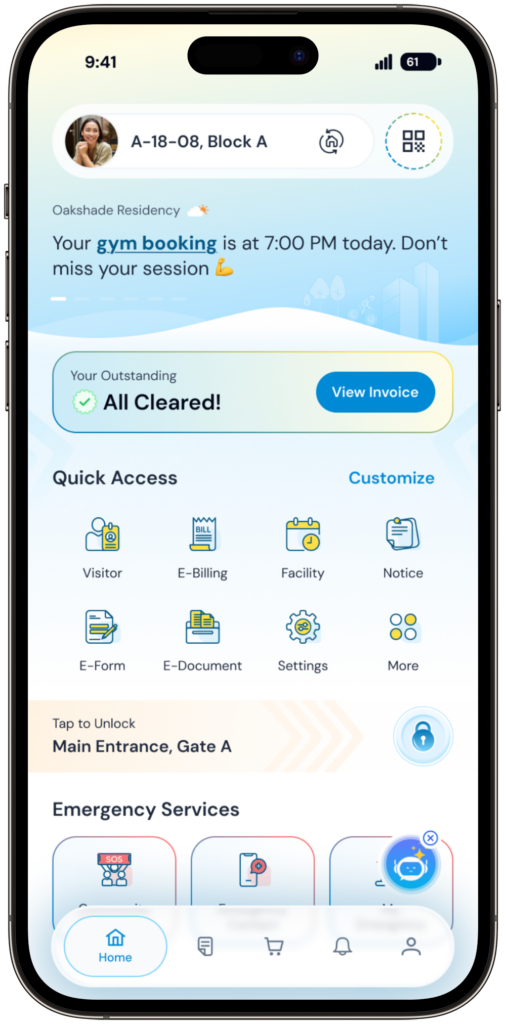
This is where the operational case for iNeighbour becomes specific to distressed developments. JMBs operating beyond their intended tenure need a system that does the work the law assumed an MC would eventually do.
User Management centralizes resident records across multiple owners per unit, tenant assignments, and committee turnover, so resident data does not degrade as occupancy changes over years rather than months. E-Billing handles maintenance fee invoicing with auto-debit, multi-gateway payment, and a billing-versus-collections dashboard that exposes arrears patterns early. Notice produces formal communications with engagement tracking, so the JMB can prove residents received and read what was sent, which matters when enforcement is challenged. The Lease module formalizes tenancy records that would otherwise sit in a committee member’s email folder.
The combination does not replace MC formation. It is the operational scaffolding that allows the JMB to function as a stable governing body for as long as the legal limbo lasts.
When Limbo Becomes Permanent
A JMB that was meant to run for two years can end up running for ten. The legal scaffolding does not adjust to that reality. The operational scaffolding has to.
If your development is operating under an indefinite JMB because the developer has gone into winding up or is in financial distress, the gap between what the law assumed and what your committee actually has to do is worth a conversation. Request a demo of iNeighbour to see how the platform supports JMBs operating beyond their intended tenure.